One of the first questions anyone asks after a mechanic says it’s time for a new battery is how much this is going to cost. The answer depends on your vehicle type, the battery brand, the spec (standard, EFB, or AGM), and where you buy. Car battery replacement cost in Thailand is generally reasonable by international standards, but it varies widely enough that knowing the ranges before you shop makes a real difference.
This is the national, big-picture guide: honest THB price ranges by vehicle type and battery tier, a clear explanation of what drives costs up or down, and practical advice on how to avoid overpaying anywhere in the country. If you’re specifically in Phuket and want the local, come-to-you picture — mobile fitting prices, the rental-car and tourist angle, and our all-in no-surcharge promise — see how much a car battery costs in Phuket.
Note on prices: All figures below are approximate retail ranges based on typical market pricing as of mid-2026. Actual prices vary by supplier, location, and specific battery model. Always confirm current pricing directly with your supplier. For Battery Fast Phuket’s current rates, see our pricing page.
Battery Replacement Costs by Vehicle Type
This table covers the most common vehicle categories across Thailand — from the small city cars that fill Bangkok traffic to the large pickup trucks that dominate provincial roads.
| Vehicle Type | Battery Size | Approximate Cost Range (THB) | Notes |
|---|---|---|---|
| Economy / small city car | Group 42B | 1,500–2,500 | Toyota Vios, Honda City (older), Mitsubishi Mirage |
| Standard sedan / hatchback | Group 55B / 75D | 2,500–3,800 | Honda Jazz, Toyota Yaris, Mazda 2 |
| Mid-size sedan / crossover | Group 80D / 95D | 3,200–4,800 | Honda CR-V, Toyota Camry, Mazda 6 |
| SUV / pickup truck | Group 100D / 120D | 3,500–5,500 | Toyota Fortuner, Ford Ranger, Isuzu D-Max |
| Large truck / 4WD | Group 130E / 150E | 4,500–6,500 | Toyota Hilux Revo (some configs), Mitsubishi Pajero |
| Premium AGM (all sizes) | Varies | 5,000–8,500+ | Stop-start vehicles, European cars, BMWs, Benz |
| European / luxury vehicles | Varies | 6,000–12,000+ | BMW, Mercedes, Volvo — OEM specs required |
All prices are for supply and installation of a new battery. The battery size group codes are the JIS (Japanese Industrial Standard) designations used throughout Thailand and Southeast Asia — they appear on the battery label and in your owner’s manual.
Economy Tier: 1,500–2,500 THB
Budget batteries in this range are typically from smaller Thai or regional brands, and occasionally older stock from established brands. They’re generally standard flooded lead-acid batteries and work adequately in appropriate-sized vehicles.
Who this suits: Budget-conscious owners of small, older vehicles with modest electrical demands and no stop-start system. If you have a basic city car and drive regularly (giving the alternator time to keep the battery charged), an economy battery can perform acceptably — though in Thailand’s heat expect to replace it in 18–24 months rather than 2–3 years.
What to watch: Avoid putting a budget battery in a vehicle with heavy air-conditioning use, an advanced infotainment system, or any stop-start functionality. The extra electrical demands will shorten its life dramatically.
Mid-Range Tier: 2,500–4,800 THB
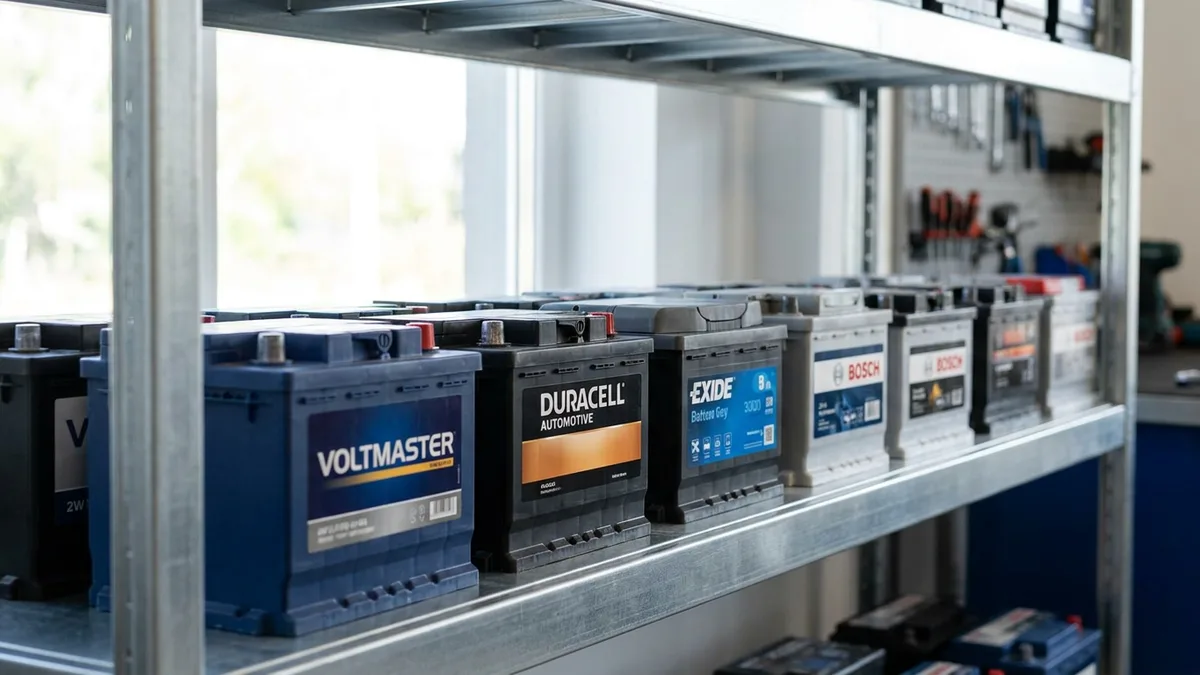
This range covers batteries from established brands — Amaron, GS Yuasa, Panasonic, Exide, and others — in standard flooded or EFB configurations. This is where most passenger car replacements in Thailand land.
A mid-range battery from a reputable brand is the right choice for most common vehicles on Thai roads. These batteries balance cost, quality, and warranty coverage well, and brands like Amaron and GS Yuasa have a strong track record in tropical climates.
What affects the price within this range:
- Brand reputation — Amaron and GS Yuasa typically sit at the higher end of mid-range; locally distributed generics at the lower end
- Battery capacity (Ah) — higher amp-hour ratings cost more
- Cold cranking amps (CCA) — less relevant in Thailand’s climate but higher CCA ratings push prices up
- Warranty length — a 24-month warranty battery costs more than a 12-month equivalent
Premium / AGM Tier: 5,000–8,500+ THB
AGM (Absorbed Glass Mat) batteries are required by some vehicle manufacturers and strongly recommended for others. Any car with stop-start technology originally fitted with an AGM battery must be replaced with AGM or better — fitting a standard flooded battery will cause premature failure.
Premium AGM batteries from brands like Varta, Bosch, Optima, or AGM variants from Amaron and GS Yuasa command higher prices. For European vehicles — especially BMW, Mercedes-Benz, and Volvo — the battery specification (capacity, CCA, and battery management system compatibility) is precise, and fitting the wrong spec can trigger fault codes. In these cases, spending more to get the right battery from a knowledgeable supplier is genuinely the better long-term value.
What Drives the Final Cost Up or Down
Beyond the basic battery tier, several factors affect what you’ll actually pay:
Brand Choice
Brand matters more in Thailand than in some markets because distribution quality and counterfeit risk are real. Established brands — Amaron (distributed by Amara Raja), GS Yuasa, and Panasonic (Caos) — are widely trusted and their products are consistently what they claim to be. Generic or unfamiliar brands may be priced attractively but carry higher risk of early failure.
Point of Purchase
- Wholesale battery shops — often the lowest prices, particularly for standard batteries bought in person
- PTT, Caltex and other service-station bays — convenient, reliable, typically mid-range pricing
- B-Quik, Cockpit and similar auto service centres — branded chains; competitive pricing with fixed-cost transparency
- Car dealership service centres — premium pricing; OEM-spec batteries, which matters for some European vehicles
- Mobile battery services — comparable to retail for the battery itself; the value is in convenience and 24/7 availability
Old Battery Trade-In
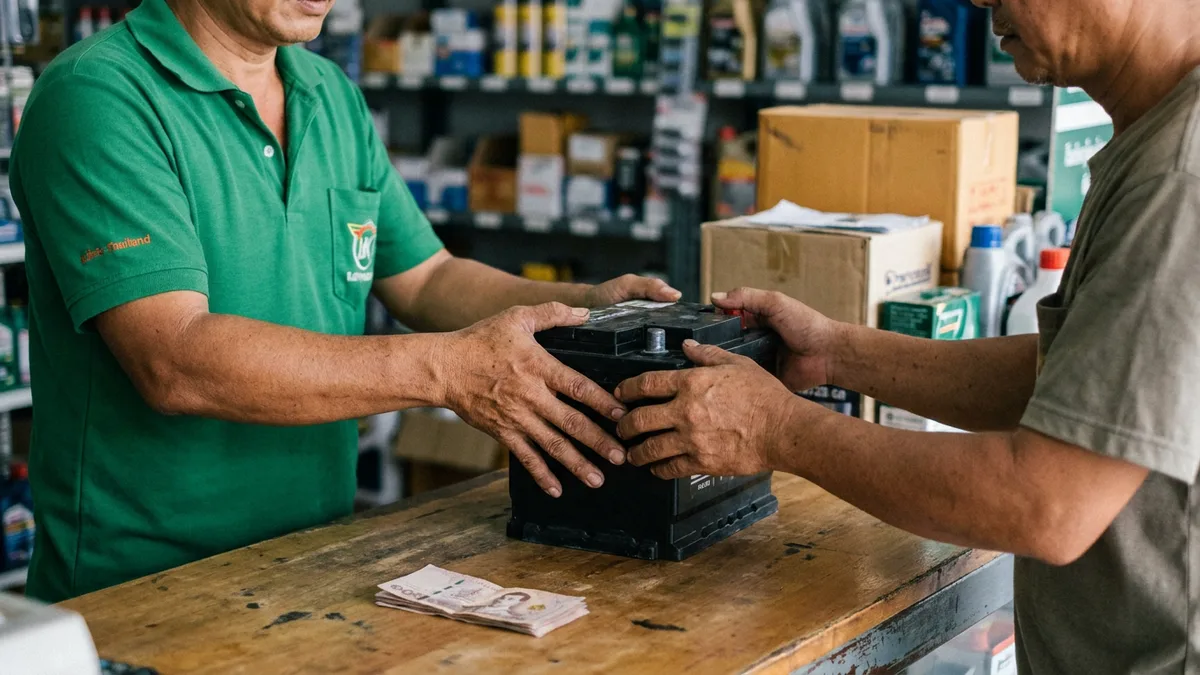
When you buy a replacement battery in Thailand, most suppliers will take your old battery as a trade-in (sometimes called a “core charge”). The credit value is usually 200–500 THB and is often already factored into displayed prices. If a price seems unusually low, confirm whether it requires you to hand over the old battery.
Installation Complexity
Standard battery installation is nearly always included in the quoted price or costs only a few hundred baht extra. However, if your battery is in a non-standard location — boot-mounted in some European sedans, under a rear seat, or behind a complex engine bay panel — labour time increases and so does the cost.
Shop Price vs. the Real Cost of a Flat Battery
The sticker price of the battery is only part of the equation. If the battery has already gone flat and the car won’t start, a traditional shop also costs you a tow (typically 500–1,500 THB depending on distance), the wait, and the lost time while they source and fit the unit. A mobile battery service brings the right battery to your location instead, so the battery itself is priced comparably to retail and you pay only for the convenience.
That come-to-you economics is where local pricing matters most. For exactly what mobile fitting costs in Phuket — bundled all-in with delivery and installation, no callout fee — see how much a car battery costs in Phuket.
How to Avoid Overpaying
A few habits keep you on the right side of fair pricing anywhere in Thailand:
- Know your group size before you shop. Read the code off your existing battery label (or your owner’s manual) so a supplier can’t upsell you into a larger, pricier battery than your car needs.
- Get the all-in figure. Confirm whether installation, the old-battery trade-in, and any disposal are already included, or quoted as extras on top.
- Compare like for like. A cheaper quote on an unfamiliar brand with a shorter warranty isn’t really cheaper. In Thailand’s heat, a battery that fails after 14 months costs you more in total than one that lasts 30 months did upfront.
- Stick to trusted brands. The small saving on an unknown brand rarely survives the first early failure.
As a rough planning guide, allow 3,000–4,500 THB every 2–3 years for a quality mid-range battery in a small-to-mid-size car, 4,500–6,000 THB per cycle for an SUV or pickup, and 7,000–12,000 THB for a European car fitted by a supplier who understands its battery-management requirements.
For brand-specific recommendations and how to match the right battery to your vehicle, our guides on the best car battery brands in Thailand and how to choose the right car battery cover the options in detail.
If you’re in Phuket and ready to replace your battery now — or want a free health check to see whether replacement is actually needed — our car battery replacement and car battery delivery and fitting teams are available 24 hours a day, and we’ll come to you.