Walk into any auto parts shop in Thailand and ask for “a battery for my car” without knowing your vehicle’s specification, and you’ll likely get a guess — and sometimes the wrong one. Fitting an undersized or incorrectly rated battery can leave you stranded again within months. This guide gives you the knowledge to ask the right question, read a battery label, and make a confident choice before spending a single baht.
Why the Right Battery Actually Matters
A car battery isn’t a universal part. Your vehicle’s manufacturer specified a battery with particular physical dimensions, power output, and terminal configuration. Fit something too small and it won’t hold a charge under load. Fit the wrong terminal layout and you may not be able to connect the cables without forcing them — a fire risk. In Thailand’s climate, where heat already stresses batteries harder than average, starting with the wrong spec makes an already demanding environment even harder on the part.
The goal is an exact or fully compatible replacement. Here’s how to identify it.
Step 1 — Find Your Group Size Code
The most important number on any battery label is the group size code. In Thailand (and most of Asia), this follows the JIS (Japanese Industrial Standard) format. It looks like this:
40B19L
Each part of that code means something specific:
- 40 — Performance rating (a proxy for capacity and power; higher is more capable)
- B — Battery width category
- 19 — Battery length in approximate centimeters
- L — Terminal position: L means the positive (+) terminal is on the left when you’re looking at the battery from the front; R means it’s on the right
The group size on your replacement must match in width, length, height, and terminal position. A battery that doesn’t fit the tray or reach the cable connectors simply won’t work.
Where to find your group size:
- Printed on the label of your existing battery
- Listed in your car’s owner’s manual under “battery specifications”
- Available from a dealer or service manual lookup by VIN
Step 2 — Understand Reserve Capacity and Amp-Hours (Ah)
Amp-hours (Ah) measure how much total energy the battery can store. A 45 Ah battery can theoretically deliver 1 amp for 45 hours before going flat. For practical purposes, a higher Ah rating means more energy reserve — useful if your car has heavy electrical accessories, a dash cam, or a subwoofer.
In Thailand, most standard passenger cars use batteries in the 35–60 Ah range. Pickup trucks and SUVs often use 65–100 Ah.
You can generally go slightly higher in Ah than your original battery without any issue. Going lower is a mistake — your battery will struggle to run all your car’s electrical systems and will discharge faster.
Step 3 — Know Your CCA Rating
Cold Cranking Amps (CCA) measures how much current a battery can deliver during a cold start. In Phuket, where temperatures never approach freezing, CCA is less critical than it would be in Norway — but it’s still a useful quality indicator. A battery with a higher CCA has more robust internal construction and plate thickness, which also means better heat tolerance.
Don’t go below your manufacturer’s specified CCA. Going higher is always acceptable.
Step 4 — Terminal Layout and Cable Reach
The terminal layout — which side the positive post is on, and the height of the terminals — determines whether your battery cables will reach without stretching. Stretching cables creates stress on connectors and can cause arcing.
L (Left positive) and R (Right positive) are the two variants for JIS batteries. Always match this to your existing battery unless you know your vehicle’s cable length allows otherwise.
Step 5 — Maintenance-Free vs. Conventional Wet Cell
| Type | Description | Best For |
|---|---|---|
| Maintenance-free (sealed) | No water top-up needed; sealed case | Modern cars, most drivers |
| Conventional wet cell | Removable caps; electrolyte can be checked | Older vehicles, infrequent use |
| AGM (Absorbed Glass Mat) | Sealed, spill-proof, high cycle life | Start-stop vehicles, European cars |
| EFB (Enhanced Flooded Battery) | Improved wet cell; for mild start-stop | Entry-level start-stop vehicles |
Most cars made after 2005 use maintenance-free batteries. If your car has a start-stop system (the engine cuts out automatically at red lights), check whether it requires AGM or EFB — fitting a standard battery to a start-stop car will dramatically shorten its life.
Reading the Battery Code: A Real Example
Say your current battery is labeled 75D23R:
- 75 — Performance/capacity category (a larger number than 40, so this is a bigger, more powerful battery)
- D — Width class (wider than B)
- 23 — Length category (~23 cm)
- R — Positive terminal on the right
This is a common fitment for mid-size sedans and some SUVs in Thailand (Toyota Camry, Honda Accord, Mazda 6). The replacement must be a 75D23R — or a manufacturer-approved upgrade like an 80D23R, which is slightly more powerful in the same physical size.
Using Your Owner’s Manual
If you can’t read the existing battery label (it’s often faded after a few years in the sun), your owner’s manual is the authoritative source. Look for “battery” in the index. It will list the minimum group size, minimum CCA, and whether AGM is required.
No manual? A quick search of “[your car make + model + year] battery specifications” usually turns up forum threads or dealer spec sheets with the answer.
Get a Professional Check Before You Buy
If you’re unsure, the safest move is to have your existing battery tested before replacing it. Sometimes what feels like a failing battery is actually a charging system issue — replacing the battery won’t fix the problem.
Our battery testing service uses a load tester to measure your battery’s actual health and cranking output. We’ll tell you whether your battery needs replacing and, if it does, which model is the correct replacement for your vehicle.
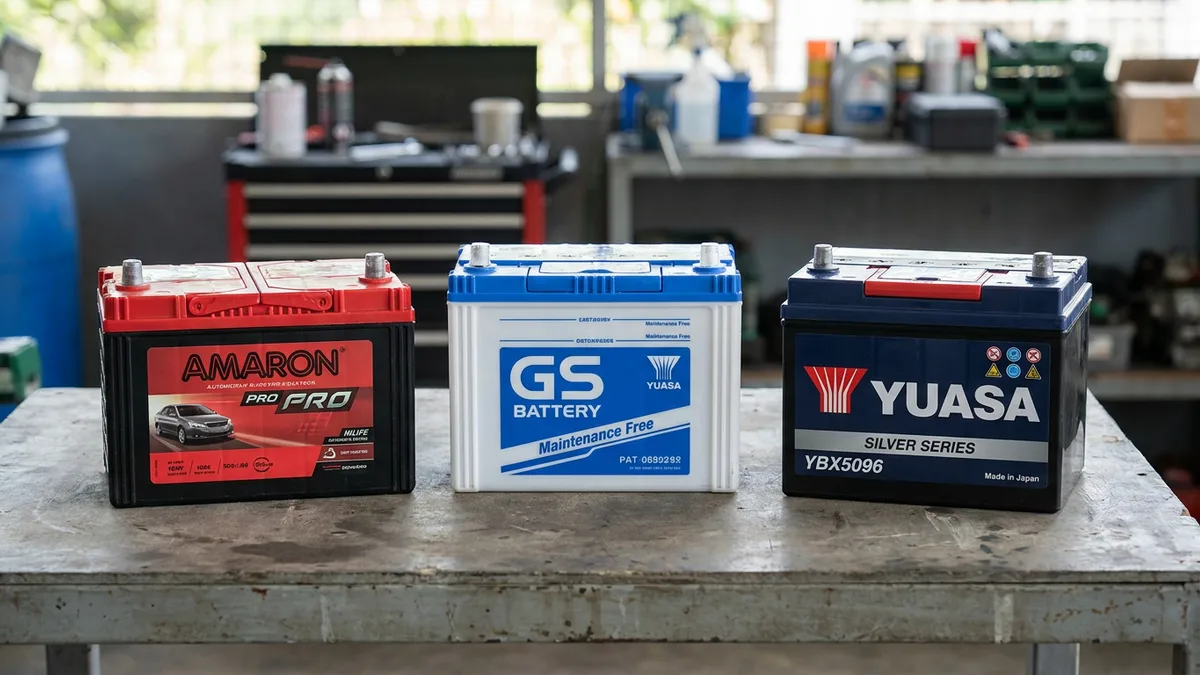
Once you’ve identified the right spec, our car battery replacement service carries the full range of brands — from Amaron and GS to Yuasa — and we’ll fit the correct battery at your location in Phuket, no guessing involved.