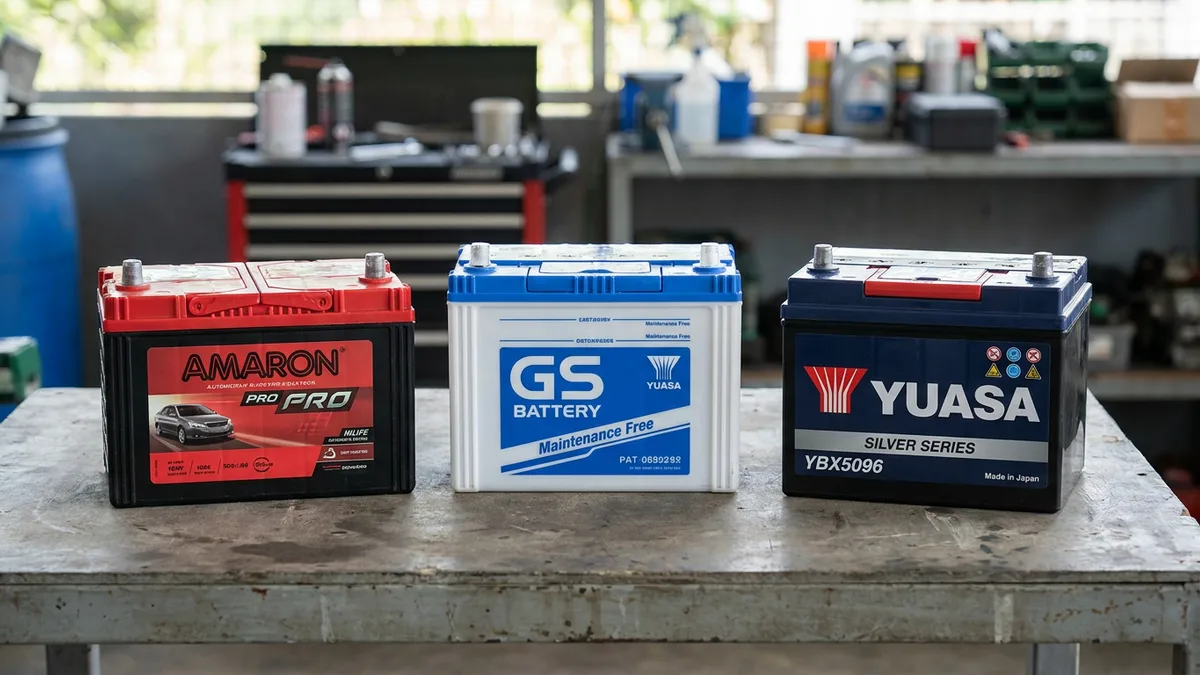
If you ask three different mechanics in Phuket which battery brand they recommend, two of them will say Amaron, one will say GS, and at least one will mention Yuasa. All three are legitimate answers — these are the three most popular, most trusted, and most widely available replacement battery brands in Thailand. The real question isn’t which is best in the abstract, but which is best for your car, your driving habits, and your budget.
Here’s an honest head-to-head.
The Quick Comparison
| Factor | Amaron | GS | Yuasa |
|---|---|---|---|
| Origin | India (Amara Raja) | Japan (GS Yuasa, regional manufacture) | Japan |
| Heat resistance | Excellent | Good | Good |
| Typical warranty | Up to 24 months | 12–15 months | 12 months |
| Price tier | Mid-upper | Mid | Mid-upper |
| Best for | Hot climates, daily drivers | All-round reliability, wide fitment | Japanese-brand vehicles, OEM match |
| Availability in Phuket | Excellent | Excellent | Good |
| AGM variant available | Yes | Yes | Yes |
Amaron: The Heat Specialist
Amaron is manufactured by the Amara Raja Group in India — a country with a climate that puts batteries through serious punishment. Indian summer temperatures can hit 45 °C or more at the surface, and under-bonnet temperatures are significantly higher. Building batteries for that environment produced a product that handles Phuket’s year-round heat unusually well.
The key technology is silver alloy in the battery plates, which Amaron markets as Hi-Life technology. Silver improves conductivity and reduces corrosion, which means the plates last longer before degrading under heat cycling. Amaron also claims a low self-discharge rate, so a car that sits parked in a hot car park for a week won’t return to a dead battery.
The 24-month warranty is the longest of the three — roughly double GS’s and Yuasa’s standard terms — and is frequently cited by mechanics as a sign of the manufacturer’s confidence in the product.
Amaron works best for: Daily drivers in Phuket, vehicles regularly parked in the sun, owners who want maximum heat tolerance and the longest warranty.
The tradeoff: Slightly higher price than GS for an equivalent size.
GS Battery: Thailand’s Default
GS Battery is arguably the most widely installed brand in Thailand — you’ll find it in dealerships, at roadside garages, and quoted as the standard option by most mechanics who don’t have a strong brand preference either way.
GS is a division of the GS Yuasa Corporation, Japan’s largest battery manufacturer. Batteries sold as “GS” in Thailand are manufactured in the region under GS Yuasa’s quality standards, which gives them solid engineering at a more accessible price point than the parent company’s Yuasa-branded products.
GS covers an enormous range of vehicle types. Whatever you drive — city hatchback, pickup truck, large SUV — GS almost certainly makes a compatible battery. The fitment range is its biggest practical advantage.
Performance in Thailand’s heat is good. Not exceptional, not the class leader, but reliably competent across a broad range of conditions. Most GS batteries in Phuket last 2 to 3 years with normal use.
GS works best for: Owners who want a reliable, widely available brand at a moderate price; vehicles where exact fitment is hard to source in other brands.
The tradeoff: Shorter typical warranty than Amaron; heat performance is good but not optimized for tropical climates the way Amaron is.
Yuasa: The Japanese OEM Reference
Yuasa is the brand that many Japanese vehicle manufacturers — Toyota, Honda, Mitsubishi — use as original equipment. If your car rolled off the production line with a Yuasa battery installed, fitting a Yuasa replacement is the closest thing to a factory spec swap you can get.
Japanese manufacturing quality is evident in Yuasa’s build consistency. Tolerances are tight, plate thicknesses are uniform, and the product variance batch-to-batch is low. That consistency translates to predictable performance over the battery’s life.
Yuasa’s weakness in Thailand is that some models are harder to source locally, and the warranty period can be shorter than Amaron’s on direct comparisons. Availability in Phuket is good for common fitments but may be limited for older or unusual vehicles.
Yuasa works best for: Owners of Japanese-brand cars who want an OEM-equivalent replacement; drivers who prioritize Japanese manufacturing quality and are willing to pay for it.
The tradeoff: Shorter warranty than Amaron on some models; slightly higher price than GS for equivalent capacity.
Head-to-Head: Specific Scenarios
Phuket heat and parking in the sun
Winner: Amaron. Its heat-resistant plate technology gives it a meaningful edge in sustained high-temperature environments. If your car sits in outdoor parking regularly, Amaron’s self-discharge and heat tolerance advantages are real.
Budget-conscious replacement
Winner: GS. Comparable quality to Yuasa at a slightly lower price point, with a broader fitment range than most alternatives.
OEM replacement for a Toyota or Honda
Winner: Yuasa (narrow). The OEM provenance and Japanese quality standards make it the purest like-for-like replacement. Amaron is a strong alternative with better warranty terms.
Long warranty and peace of mind
Winner: Amaron. Its up-to-24-month warranty is roughly double the standard GS and Yuasa terms.
European car with start-stop system
All three offer AGM variants. Check which is available for your specific vehicle code. In this case, brand matters less than getting the correct AGM specification.
Price Comparison (Approximate, Phuket)
| Battery | Typical Price Range (฿, incl. fitting) |
|---|---|
| Amaron (standard 40B19L/55B24L range) | 2,500 – 3,800 |
| GS (same size range) | 2,200 – 3,200 |
| Yuasa (same size range) | 2,800 – 4,500 |
Prices shift based on exact model and battery size. For pickup trucks and SUVs in larger battery sizes, all three brands cost more.
The Bottom Line
If you want the single best battery for Phuket conditions and you’re not constrained by budget: Amaron, for its heat engineering and long warranty.
If you want a reliable, proven all-rounder at a mid-range price: GS, the default choice of Thailand’s automotive trade.
If your car came with a Yuasa battery and you want the closest factory match: Yuasa, especially for Honda and Toyota vehicles.
None of these is a bad choice. The difference between a good battery and a poor one in Phuket’s climate is far larger than the difference between these three brands. Avoid the cheapest no-name options and you’re already making the right call.
Our car battery replacement service carries all three. Contact us and tell us your car make, model, and year — we’ll tell you which battery fits, what it costs, and we can have it installed at your location anywhere in Phuket, same day.