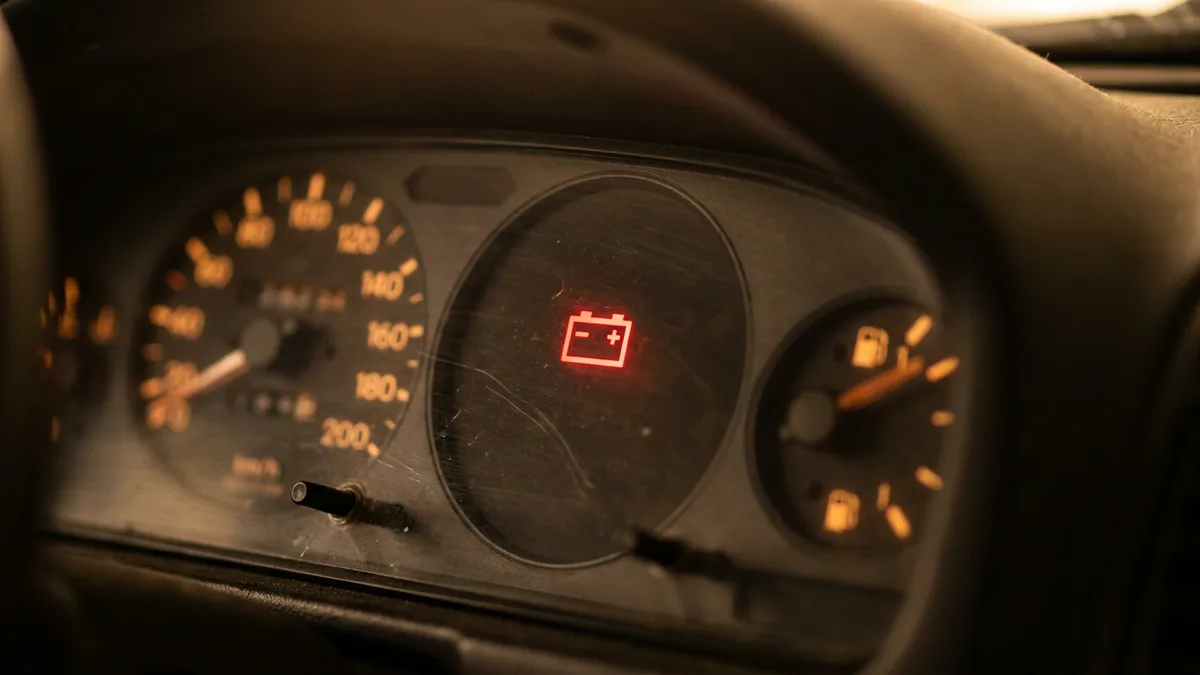
That little red battery icon lighting up on your dashboard has an unfortunate naming problem. It looks like a battery, so most people assume it means the battery is low or dying. In reality, the battery warning light is a charging system alert — and that’s an important distinction that changes how urgently you need to act and what you need to fix.
Here’s what the light is actually telling you, what to do the moment it comes on, how much time you have, and the most common causes behind it.
The Warning Light Is Not a Fuel Gauge for Your Battery
Your car doesn’t have a sensor that directly measures the stored charge inside the battery (the way a phone measures battery percentage). What it does monitor is the voltage on the electrical system while the engine is running.
A healthy charging system runs at 13.7–14.7 volts when the engine is on. The battery warning light triggers when the system voltage drops below roughly 12.5–13 volts (or occasionally spikes too high) while the engine is running — a sign that the alternator is not producing adequate power.
So when you see that light, the first question isn’t “is my battery dead?” — it’s “is my charging system working?”
What to Do the Moment It Comes On
Speed and calm matter here. Follow these steps immediately:
1. Don’t Panic, But Do Act Quickly
The light coming on doesn’t mean the car will stop in the next 30 seconds. You likely have some time — but you need to use it wisely.
2. Turn Off Everything Non-Essential
Every electrical accessory draws from the battery reserve you’re now running on. Switch off the air conditioning (the biggest draw), heated seats, rear defrost, stereo, and any auxiliary devices plugged into USB ports or the 12 V socket. Keep headlights on if it’s dark — you need those for safety.
3. Head for Safety
Do not continue to your original destination if it’s more than a few kilometres away. Navigate to the nearest safe place to stop — a petrol station, a car park, a garage. In Phuket, there’s always a petrol station nearby; aim for one.
4. Do Not Turn the Engine Off Unnecessarily
If you turn the engine off to “check,” you may not be able to restart it. Keep driving until you reach a safe, accessible stop.
5. Call for Help
Once you’re safely parked, call for a mobile diagnostic — our battery testing service includes a full charging system check and can come to your location anywhere in Phuket.
How Long Can You Drive With the Light On?
This depends on several factors: how large your battery is, how charged it was when the light came on, how many electrical accessories are running, and whether the alternator is completely dead or just weak.
In practical terms:
- All accessories off, battery was fully charged: Up to 40–60 minutes in some vehicles
- AC running, battery partially discharged: As little as 15–20 minutes
- At night with headlights on plus AC: Somewhere in between
These are rough estimates — don’t rely on them to plan a long drive. The only safe assumption once the light is on is that you have limited, unpredictable time remaining. Treat it like a low-fuel light in a remote area: get to safety now.
Common Causes of the Battery Warning Light
Failed or Failing Alternator
The most common cause. The alternator wears gradually — internal brushes wear down, bearings fail, or the voltage regulator stops controlling output properly. You may have had warning signs before the light appeared: dimming lights at idle, flickering accessories, or a faint whining noise from the engine bay.
Broken or Slipping Drive Belt
The alternator is driven by a rubber belt. If that belt snaps or slips significantly, the alternator stops spinning and output drops to zero immediately. A belt failure often comes with a loud slapping noise or burning rubber smell.
Corroded or Loose Battery Terminals
Poor connections create electrical resistance that causes voltage to fluctuate at the battery terminals, which can trigger the warning light even when the alternator is functioning correctly. This is one of the cheaper fixes — clean terminals and a proper retightening can resolve it entirely.
Faulty Battery (Internal Short or Open Cell)
A battery with a shorted cell can cause unusual voltage behavior that confuses the system monitor. If the battery is very old or physically damaged (swollen case, terminal corrosion), it may be contributing to an unstable voltage reading.
Wiring or Connection Fault
Damaged wiring between the alternator and battery, or a failing ground connection, can interrupt the charging circuit and trigger the warning without any component failure. This is less common but more common on older vehicles.
Overloaded Alternator
Adding large aftermarket electrical loads — additional amplifiers, lighting bars, inverters — without upgrading the alternator can push it beyond its rated capacity, causing voltage to sag under load.
Is It the Battery or the Alternator?
If you’re trying to narrow this down yourself, the definitive method is a voltage test. See our detailed guide on battery vs. alternator diagnosis for the step-by-step approach. In brief:
- Engine off, rested: Should read ~12.6 V. Below 12.4 V indicates the battery is undercharged.
- Engine running at idle: Should read 13.7–14.7 V. Below 13.5 V suggests the alternator is undercharging.
If you spot other signs your battery is dying in combination with the warning light, it’s possible both components are involved — especially if the alternator has been undercharging for a while.
Can You Ignore the Battery Warning Light?
No. Even if it flickers on and off intermittently rather than staying solid, intermittent charging system problems tend to get worse quickly. A slipping belt will eventually snap. An alternator with failing brushes will lose output entirely. The window where you have options and can plan your repair on your own schedule closes fast.
If the light comes on while you’re driving in Phuket, we can be on-site most locations within the hour. We’ll test the charging system, give you a clear diagnosis, and handle a battery replacement on the spot if that’s what’s needed — so you’re back on the road the same day without a workshop visit.