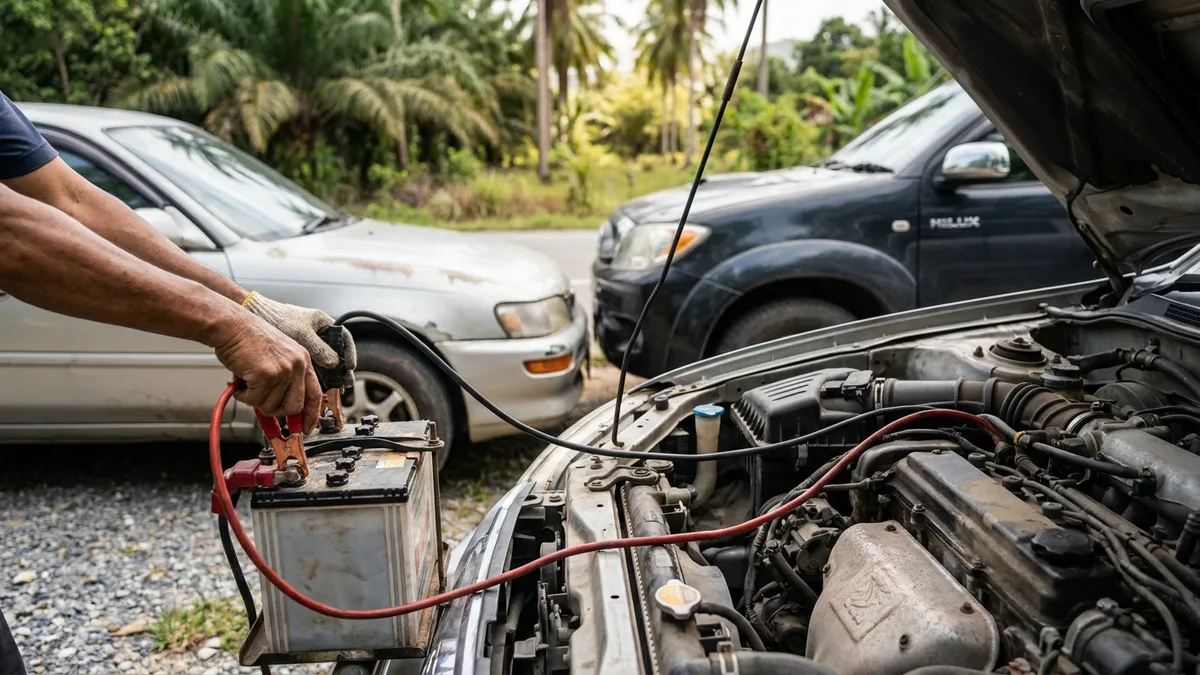
Your car battery died. You turn the key or press the start button, and nothing happens — or there is a sound that makes it obvious the car is not going anywhere under its own power. In Phuket, this moment catches drivers off guard every day. The island’s heat is hard on batteries, and two to three years is a realistic lifespan here for a standard lead-acid unit. When it goes, it usually goes without much warning.
The good news: a dead battery is one of the most solvable roadside problems there is. Take a breath, work through these steps in order, and you will have the car moving again faster than you might expect.
Step 1: confirm it is actually the battery
Before you call anyone or start looking for jumper cables, spend 30 seconds figuring out what the car is actually doing. The symptoms tell you a lot:
Signs that point clearly to the battery:
- Silence when you turn the key — no sound at all
- A single weak “thud” or click
- A rapid chattering or clicking sound (the starter solenoid trying and failing)
- Dashboard lights that are dim, flickering, or completely absent
- The car felt slow to start over the past few days before this happened
Signs that suggest something other than the battery:
- The engine cranks normally — it turns over at full speed — but refuses to fire
- Dashboard lights and electrics are fully bright and normal
- A flashing padlock or car-with-key symbol (immobiliser warning)
If you are in the first group, you almost certainly have a flat or dead battery. If you are in the second group, the battery is not the problem and a jump-start will not help — you need a different diagnosis. Our guide on why a car won’t start covers the other causes in detail.
Step 2: make sure you are safe
Before you do anything else, take care of your immediate safety.
- Turn on your hazard lights. Do this as your first action, even before you investigate the battery. It alerts other drivers immediately.
- If you are on a busy road, get the car off the road if you can do so safely, or stay well clear of traffic yourself.
- If you are parked safely — hotel car park, beach car park, side street — you can relax. You are not in immediate danger.
- Stay hydrated. Phuket is hot. If you are waiting outside the car, find shade and water.
A flat battery is not an emergency in the dramatic sense, but being stopped on a narrow Phuket road at night with no lights is. Hazards on first, always.
Step 3: decide between jump-start and full replacement
There are two paths forward, and the right choice depends on how old the battery is and whether this is a first or repeat event.
Option A: Jump-start the car
A jump-start using cables or a portable jump starter pack can get a flat battery running again in minutes. This is the right first step if:
- The battery is relatively new (under two years old in Phuket)
- This is the first time it has gone completely flat
- The car has been sitting unused for a while and the battery slowly self-discharged
- Someone left the headlights or interior lights on overnight
After a successful jump-start, drive for at least 25–30 minutes continuously — not short hops — to let the alternator recharge the battery. Then get it tested. A battery that was deeply discharged may have lost some of its capacity permanently, even after a full recharge.
Option B: Replace the battery
Replacement is the better choice if:
- The battery is two or more years old
- This is not the first time it has failed to start in recent weeks
- The car has been jump-started before and the battery keeps going flat
- A load test confirms the battery can no longer hold adequate charge
In Phuket’s heat, “nurse it along” is a strategy that usually ends with a second breakdown within days. A battery that has truly reached the end of its life will not be rescued by repeated jump-starts.
Our car battery replacement service is mobile — we come to wherever the car is, fit the battery there, and dispose of the old one. There is no need to get the car to a workshop.
Step 4: deal with the practical logistics
If you have jumper cables or a jump pack and someone to help
Follow the correct connection sequence. Connect red to the flat battery’s positive terminal first, then red to the donor’s positive, then black to the donor’s negative, then black to a bare metal point on the engine block of the flat car — not to the flat battery’s negative terminal. Start the donor car, wait two minutes, then try to start the flat car. Once running, disconnect in reverse order.
If you need a step-by-step walkthrough, our full jump-start guide covers both the cable and jump-pack methods in detail.
If you do not have equipment or a helper
Call for help. There is no shame in it, and in Phuket you have options:
- If it is a rental car, call the rental company first. Most have 24-hour roadside assistance. See our rental car battery guide for the specific steps.
- If it is your own car, call a mobile battery service — that’s us. We cover all of Phuket, 24 hours a day.
Sharing your location: This is often the trickiest part in Phuket, where roads can be narrow, unnamed, and confusing on a map. Open Google Maps, press and hold on your location to drop a pin, and share the link via LINE or WhatsApp. A GPS coordinate (for example, 7.8804, 98.3923) works even better — read it off the screen and text it over.
Step 5: once the car is running, do not ignore the next steps
A jump-start is a solution to the immediate problem. It is not a solution to the underlying one. After getting the car going:
Get the battery tested. A voltage reading alone does not tell the full story — a battery can show 12.4 V resting but fail completely under the load of starting the engine. A proper load test reveals the battery’s true health. We carry testing equipment on every callout and can do this on the spot.
Check the charging system. If the battery went flat because the alternator is not charging it properly, replacing the battery will not fix anything. The car will run on a new battery until that one is flat too. Our battery testing service includes a basic alternator output check.
Think about what caused this. Was the battery old? Was a light left on? Has the car been sitting unused? Knowing the cause helps you avoid the same situation in a week or a month.
A word on Phuket’s heat and battery lifespan
One thing that surprises many drivers — both expats and tourists — is how quickly batteries age in Phuket compared to what they are used to at home. The heat here raises the operating temperature inside the battery, which accelerates the chemical reactions that cause long-term degradation. A battery that loses a small percentage of capacity each year in a cooler climate loses capacity much faster at 35°C ambient.
This is not unique to cheap batteries. Even quality brands like Amaron, Yuasa, and GS see their warranty periods shortened in tropical climates. If your car’s battery is approaching the two-year mark in Phuket, it is worth a proactive test rather than waiting for a roadside failure at an inconvenient moment.
How our mobile service works
If your battery has died and you need help in Phuket, here is what happens when you call or message us on LINE:
- You tell us your location and what the car is doing
- We confirm we are on the way — typically within about 30 minutes anywhere on the island
- We arrive with jump-start equipment and a full stock of replacement batteries
- We test the battery and the alternator on the spot
- If a jump-start solves it, we check the battery health and advise you honestly
- If the battery needs replacing, we do it there and then — no tow, no second appointment
Our 24-hour emergency service covers every part of Phuket including Patong, Kata, Karon, Rawai, Chalong, Phuket Town, and the airport area. Call us or send a LINE message with your location, and we will get you back on the road.