You walk out to your car, turn the key, and nothing happens — or there is just a weak click and a slow, laboured crank. It is one of the most frustrating moments a driver can face, and in Phuket it happens more often than you might expect. The tropical heat here accelerates battery wear, and it is entirely common for a battery to give up after just two or three years. The car was parked at your hotel, your villa, or a beach car park; the battery drained overnight, or it simply reached the end of its life in the midday heat.
The good news is that a flat battery is one of the most straightforward car problems to solve if you have the right equipment and you follow the correct steps. This guide walks you through jump-starting a car using both traditional jumper cables and a modern portable jump-starter pack, explains what to do once the engine is running, and tells you honestly when it is time to stop trying and call for professional help.
What you’ll need
Before you start, gather the equipment. You need one of the following two options:
Option A — Jumper cables and a donor car:
- A set of heavy-duty jumper cables (the thicker the gauge, the better — cheap thin cables can overheat)
- A second car with a healthy, fully charged battery that can be parked close enough for the cables to reach
Option B — Portable jump-starter pack:
- A portable lithium jump-starter pack (often called a “jump box” or “power bank jump starter”)
- These are compact, require no second car, and are a worthwhile investment for any driver in Phuket
Both methods are equally effective for a straightforward flat-battery situation. A jump-starter pack is more convenient if you are alone or parked in a spot where another car cannot get alongside you.
Safety first
Jumping a car is safe when done correctly. Run through these checks before you touch anything:
- Park both cars on level ground and apply the handbrake on both vehicles.
- Turn off both ignitions. The donor car should be switched off initially; you will start it later.
- No smoking. A battery can release hydrogen gas, especially if it is damaged or heavily discharged.
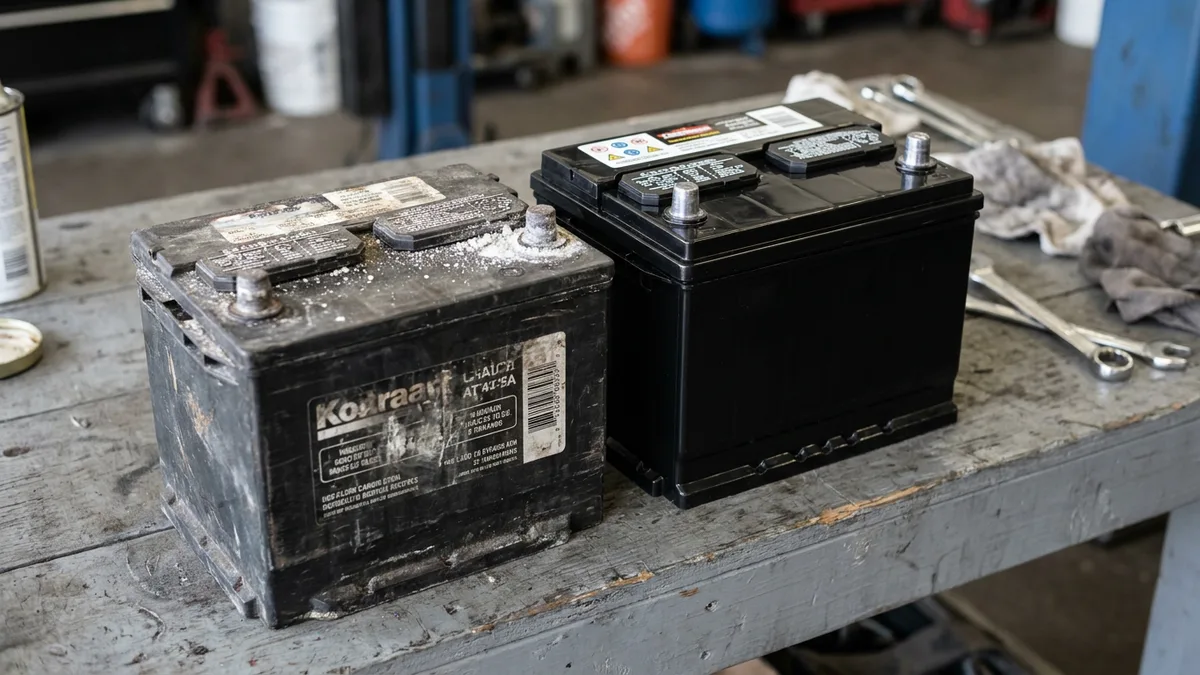
- Inspect the flat battery. If you can see cracks, a bulge, or leaking acid, do not attempt a jump-start — the battery may be unsafe. Call for assistance.
- Check the terminals. Heavy corrosion (white or blue-green powder) should be brushed off before connecting cables. A small brush or old toothbrush works.
- Keep the cable clamps away from each other and from any metal on the car at all times. Clamps touching each other — or touching the wrong terminal — can cause a short circuit or a spark.
Modern cars also carry sophisticated electronics. If either vehicle has a stop-start system, a hybrid drivetrain, or any manufacturer warnings in the handbook about jump-starting, check those instructions first.
How to jump-start a car with jumper cables
The order you connect and disconnect the cables matters. Follow this sequence precisely:
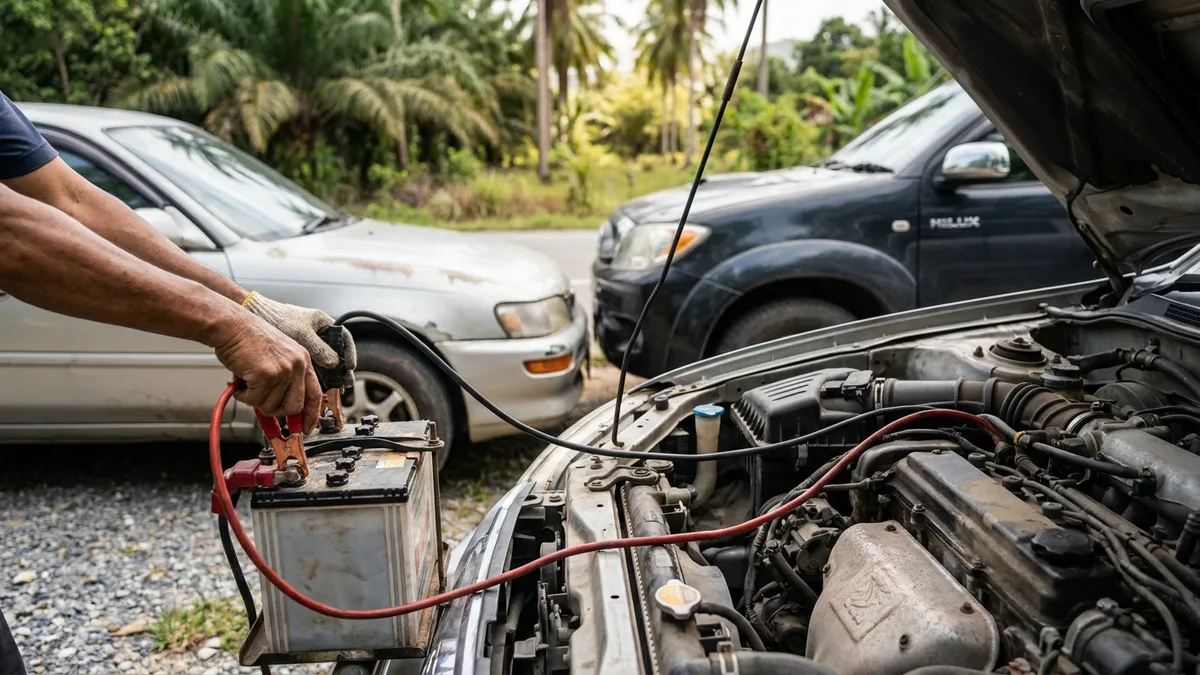
- Connect the red (positive) cable clamp to the positive (+) terminal on the dead battery. The positive terminal is usually marked with a + symbol and is often larger. The red cable clamp goes here first.
- Connect the other end of the red cable to the positive (+) terminal on the donor car’s battery. You now have a red cable running between the two positive terminals.
- Connect the black (negative) cable clamp to the negative (−) terminal on the donor car’s battery. This is the black terminal, usually marked with a − symbol.
- Connect the other end of the black cable to an unpainted metal surface on the dead car — not to the dead battery’s negative terminal. A bolt on the engine block, a metal bracket, or any bare metal away from the battery works well. This grounding step reduces the risk of a spark near the battery.
- Start the donor car and let it run for two to three minutes. This allows some charge to transfer to the flat battery.
- Try to start the dead car. If it cranks but does not fire, wait another two minutes and try again. If it still will not start after two or three attempts, the battery may be too far gone to accept a charge — see the section below on when to call for help.
- Once the dead car is running, remove the cables in the reverse order: black from the grounded metal on the previously dead car, black from the donor’s negative terminal, red from the donor’s positive terminal, red from the previously dead car’s positive terminal.
Keep both cars running while you remove the cables, and do not switch off the revived car straight away.
How to use a portable jump starter
A portable jump-starter pack simplifies the process considerably. You do not need a second car, and you can use it alone at the roadside.
- Make sure the jump-starter pack is charged. A half-discharged pack may not have enough power. Keep it topped up at home.
- Turn off the car ignition.
- Connect the red clamp to the positive (+) terminal on the flat battery.
- Connect the black clamp to an unpainted metal surface on the car body or engine block — same grounding principle as with jumper cables.
- Switch the jump starter on (most units have a power button or a safety interlock button you press first).
- Wait 30 seconds, then attempt to start the car.
- If the engine fires, switch the jump starter off before disconnecting. Then remove the black clamp first, then the red clamp.
- If the car does not start after two attempts with a reasonable pause between them, do not keep trying — repeated attempts can overheat the pack and stress the starter motor.
What to do after a successful jump-start
Getting the engine running is only the first step. What you do in the next hour matters.
Drive continuously for at least 20–30 minutes. The alternator recharges the battery while the engine runs, but it needs time to do so. A short drive around the block is not enough. In Phuket, a run along Highway 402 or out towards the airport is ideal — steady speed, not stop-start city traffic.
Do not switch off the engine unnecessarily. If you stop for fuel, leave the engine running. Avoid turning on high-drain accessories like air conditioning at maximum or heated rear windows until the battery has had time to recover.
Get the battery and alternator tested as soon as possible. A jump-start tells you the battery was flat; it does not tell you why. A battery that has dropped to a critically low state may never fully recover — its internal chemistry can be permanently damaged by deep discharge. A proper load test will confirm whether the battery is holding charge or needs replacing.
Do not ignore repeated failures. If the car needs a jump-start more than once in a short period, the battery is telling you something. In Phuket’s heat, batteries rarely give a second warning.
Why did my battery die?
Understanding the cause helps you avoid being stranded again. The most common reasons for a flat battery in Phuket are:
Age. A standard lead-acid battery typically lasts four to five years in a temperate climate, but in Phuket’s heat and humidity, two to three years is realistic. If your battery is approaching that age, it is worth having it tested before it fails at an inconvenient moment.
Lights or accessories left on. Interior lights, headlights left on after parking, phone chargers drawing power with the ignition off — any of these can drain a battery overnight.
Short trips and infrequent use. If you only drive the car for short hops around town, the alternator never gets long enough to fully recharge the battery. Cars that sit unused for a week or more will also slowly self-discharge. This is very common in Phuket, where many residents have a second car that rarely gets used, or rental and lease cars that sit idle between bookings.
Parasitic drain. Some electrical fault in the car draws power even when everything is switched off. This can be a faulty alarm system, a stuck relay, or a poorly fitted aftermarket accessory.
Failing alternator. If the alternator is not charging the battery properly while the engine runs, the battery will gradually discharge and eventually be too flat to start the car. This is distinct from a battery problem but produces the same symptom.
Heat accelerates all of these issues. High temperatures increase the rate of the chemical reactions inside the battery, speeding up degradation. Cars parked in direct sun for hours every day — which is almost unavoidable in Phuket — face this stress constantly.
When to call for help instead
Jump-starting works well for a straightforward flat battery, but there are situations where attempting it yourself is either unsafe or likely to be fruitless:
- The battery is visibly damaged — cracked, bulging, or leaking. Do not attempt a jump-start; the battery needs to be removed safely.
- You see sparks when connecting the cables. If following the correct sequence still produces large sparks, disconnect immediately and call for help.
- The car has been jump-started multiple times in recent days. This points to a deeper electrical fault that a jump-start will not fix.
- The engine cranks but will not fire. Once the battery is charged enough to crank the starter, but the engine still does not start, the issue is not the battery — it could be fuel, ignition, or a more serious fault.
- You are not confident. There is no shame in calling a professional. Connecting cables incorrectly on a modern car with sophisticated electronics can damage the ECU or other modules.
If you are in Phuket and need help, our mobile jump-start service can reach you anywhere on the island in about 30 minutes, any time of day or night. We carry professional jump-start equipment and a stock of replacement batteries on board — so if the boost does not hold and the battery needs replacing, we can replace the battery on the spot in a single visit, with no second callout.
If you are not sure whether your battery is the problem or whether it can be saved, the honest answer is to have it tested properly. Call us or message us on LINE, tell us where you are and what the car is doing, and we will be with you shortly.