The number on your multimeter tells a story — if you know how to read it. Car battery voltage isn’t just one number; it changes depending on whether the engine is off, running, or cranking, and it shifts with temperature, age, and the battery’s state of charge. Understanding what each reading means puts you in control instead of guessing.
This is the in-depth reference guide — if you just want the numbers, see how many volts is a car battery for the quick answer. This page covers the full voltage picture: the state-of-charge chart, the three measurement conditions that matter, what abnormal readings reveal about your charging system, and why Phuket’s heat makes the interpretation slightly different from what you might read on a European or American automotive site.
Why a “12-Volt” Battery Doesn’t Read 12 Volts
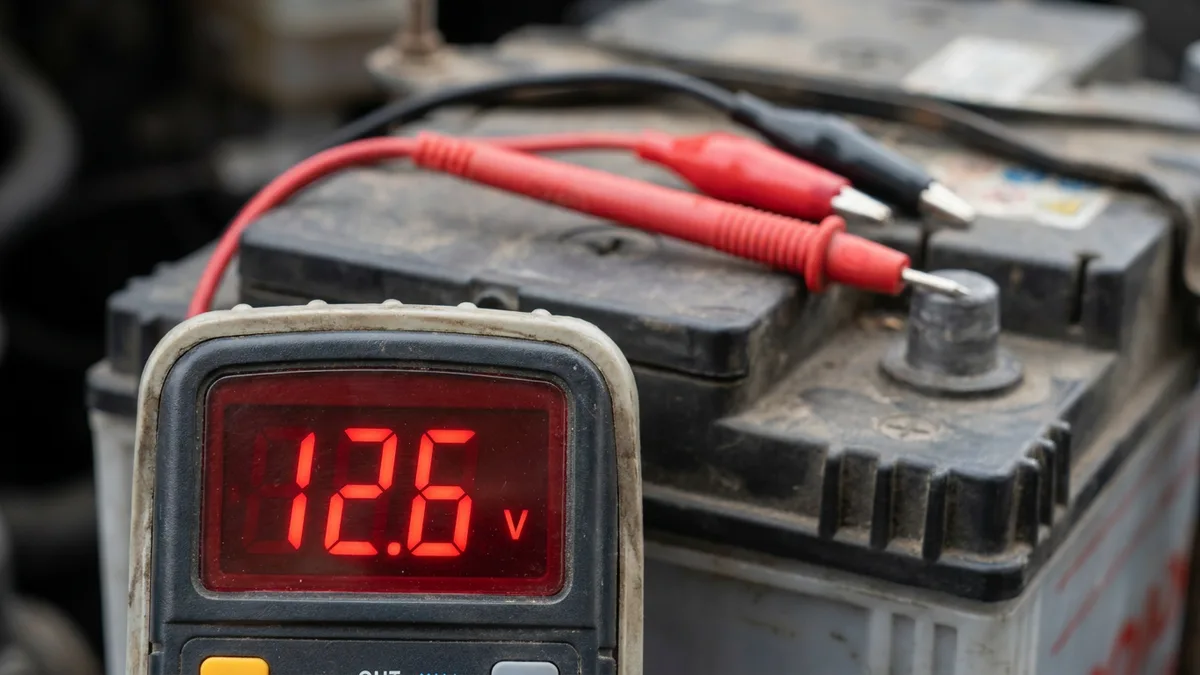
The label says 12 V, but a healthy, fully charged lead-acid battery actually rests at about 12.6 volts. The “12 V” designation refers to the battery’s nominal voltage — a rough classification used to distinguish it from 6 V motorcycle batteries or 24 V truck systems. The actual resting voltage of a charged battery is always higher than the nominal value.
A battery reads exactly 12.0 V when it’s approximately 25% charged. By the time you get to 11.8 V, the battery is nearly flat. So when someone says “my battery shows 12 volts” they’re describing a battery that is seriously depleted, not a healthy one.
This is one of the most common misunderstandings among drivers who check battery voltage for the first time.
The State-of-Charge Voltage Chart
The following values apply to a standard 12 V flooded lead-acid battery at rest — meaning no load and no recent charging or discharging. The battery should have been sitting for at least 30 minutes, ideally longer. Temperature assumed around 25 °C (77 °F), which is roughly a shaded, ventilated space in Phuket.
| Open-Circuit Voltage | State of Charge | Practical Meaning |
|---|---|---|
| 12.70 V or above | 100% | Fully charged |
| 12.60 V | ~95–100% | Fully charged (common target) |
| 12.50 V | ~85–90% | Good — slight discharge |
| 12.40 V | ~75% | Partially discharged |
| 12.20 V | ~50% | Half flat — recharge soon |
| 12.00 V | ~25% | Heavily discharged |
| 11.80 V | ~10% | Near empty |
| Below 11.80 V | 0–10% | Critically low — may not start |
A fully healthy battery at rest should measure at or above 12.6 V. Anything consistently below 12.4 V after a full overnight rest indicates a battery that either needs charging or is losing its ability to hold charge. For a step-by-step guide to taking this measurement, see how to test a car battery with a multimeter.
The Three Voltage Conditions That Matter
Car battery voltage behaves differently under three distinct conditions. Reading only the resting voltage gives you an incomplete picture. Here’s what each condition reveals:
1. Resting (Open-Circuit) Voltage
This is the measurement taken at least 30 minutes after the engine was last run or the battery was last charged. It gives you the state of charge — how much energy is stored. It does not tell you whether the battery can actually deliver that energy under load, which is a different question.
Use resting voltage to determine if the battery is charged. Don’t use it alone to conclude the battery is healthy.
2. Cranking Voltage
This is the voltage measured at the battery terminals while the engine is cranking — the moment the starter motor is engaged. This is the peak demand event. Cranking draws hundreds of amps from the battery in a very short window.
During cranking, voltage always drops — that’s expected. The question is how far:
- 9.6 V or above: Battery is delivering adequate current. Generally acceptable.
- 9.0–9.5 V: Marginal. The battery may start the car today but likely has reduced capacity.
- Below 9.0 V: Battery is struggling significantly. At risk of not starting, especially in the heat of the afternoon when engine oil is thicker and demands more current to crank.
The cranking voltage test is the single most useful quick diagnostic, because it reveals capacity under real-world load conditions.
3. Charging Voltage (Engine Running)
Once the engine starts, the alternator takes over and pushes voltage up to 13.7–14.7 V. This is not the battery voltage anymore — it’s the system voltage, which includes the alternator’s output.
| Running Voltage | What It Indicates |
|---|---|
| 13.7–14.7 V | Alternator charging normally |
| 13.5–13.6 V | Low — alternator may be weak |
| Below 13.5 V | Charging system problem — investigate |
| Above 14.8 V | Possible voltage regulator fault — overcharging |
If your running voltage is outside the 13.7–14.7 V window, the issue may be the alternator or voltage regulator, not the battery. Our guide on battery vs. alternator problems helps you tell the difference.
How Temperature Affects Car Battery Voltage
This matters especially in Phuket. The relationship between voltage and state of charge assumes a standard temperature around 20–25 °C. In reality:
- Higher temperatures push open-circuit voltage slightly upward. A battery in 35 °C ambient heat might read 12.7 V when it’s actually at about 90% charge. This can make a battery look healthier than it is on a hot day.
- Higher temperatures also accelerate self-discharge. A battery that reads 12.6 V in the morning may drop to 12.2 V by the following day if left in a hot, uncovered parking spot — not because of a fault, but because heat accelerates the natural chemical self-discharge process.
- Very high temperatures reduce cranking performance, because heat-degraded batteries have higher internal resistance, which causes a steeper voltage drop under load.
Professional battery analyzers used by our technicians apply automatic temperature compensation so the readings account for ambient conditions. A multimeter does not — which is why professional testing is more accurate than a DIY voltage check on a hot Phuket afternoon.
What Abnormal Readings Actually Tell You
| Symptom | Likely Cause |
|---|---|
| Resting voltage below 12.0 V repeatedly | Battery deeply discharged or failing |
| Battery won’t charge above 12.2 V | Sulfation or internal damage |
| Resting 12.6 V but cranks below 9.0 V | Internal capacity loss — replace |
| Running voltage below 13.5 V | Alternator or charging system issue |
| Running voltage above 14.8 V | Voltage regulator fault |
| Voltage fluctuates wildly while running | Loose connections or alternator fault |
AGM Batteries — Slightly Different Numbers
AGM (Absorbent Glass Mat) batteries, found in many European cars, modern stop-start systems, and premium Japanese vehicles, have slightly higher resting voltages than conventional flooded batteries:
- Fully charged AGM: 12.8–12.9 V at rest.
- 50% charge AGM: approximately 12.5 V.
Applying the flooded-battery chart to an AGM battery will make it appear more charged than it actually is. If you’re not sure which type your car uses, check the label on the battery or consult your owner’s manual.
Putting It Together — Your Quick-Reference Summary
- 12.6 V or above at rest = fully charged, healthy starting point.
- 12.0 V at rest = 25% charged — needs attention.
- Below 11.8 V at rest = critically flat — may not start.
- 9.6 V or above during cranking = acceptable delivery.
- Below 9.6 V during cranking = weak battery.
- 13.7–14.7 V with engine running = alternator working correctly.
If your numbers fall outside these ranges, the next step is a professional load test. Our battery testing service provides a complete voltage and capacity analysis using calibrated digital equipment, with results in under two minutes. We carry replacement batteries in our service vans and are available 24 hours a day throughout Phuket, so the answer to what your battery needs can come to you rather than requiring a garage visit.