Catching a failing battery before it leaves you stranded is one of the cheapest wins in car ownership. The problem is that most drivers don’t check their battery at all until the morning they turn the key and hear nothing but a sad click. In Phuket, where temperatures regularly push above 33 °C and humidity accelerates corrosion, that timeline can be brutally short — a battery that seemed fine a few months ago can quietly collapse over a sweltering long weekend.
Knowing how to check car battery health doesn’t require an engineering degree. It’s a three-step process: look at it, measure it, then test it under load. Each step catches a different kind of failure, and together they give you a complete picture in under ten minutes.
Step 1 — Visual Inspection (Start Here, Always)
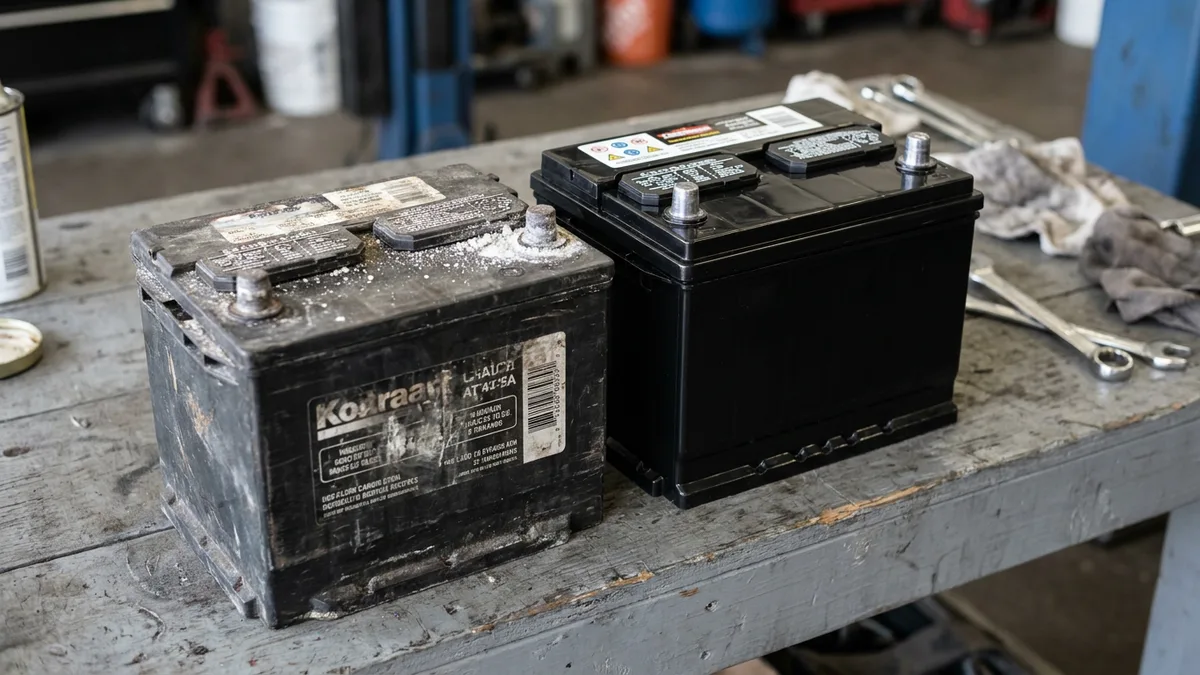
Before you reach for any tool, open the bonnet and take a close look at the battery. You’re checking for physical damage that can cause immediate failure or a safety hazard.
What to look for:
- Corrosion on the terminals — white, blue, or greenish powder on the positive (+) or negative (−) posts is a very common sign of leaking gases. A small amount is normal; heavy buildup can increase resistance and prevent proper charging.
- Swollen or bulging case — heat causes gas buildup inside the battery. A case that is no longer rectangular and flat is a clear sign the battery has been overheated or overcharged and should be replaced immediately.
- Cracks or leaks — any wetness, acid staining on the battery tray, or visible cracks means the battery needs to come out now.
- Loose or damaged cables — a corroded cable clamp can mimic a dead battery. Make sure both terminals are tight and the cable insulation is intact.
- Check the manufacture date — most batteries have a sticker showing the month and year. In Phuket’s climate, anything older than two and a half years deserves a close look even if it’s starting fine.
If you spot heavy corrosion but the battery otherwise looks intact, cleaning the terminals with a wire brush and a baking-soda paste can restore proper conductivity. Our guide on cleaning corroded battery terminals covers the process step by step.
Step 2 — Voltage Test With a Multimeter
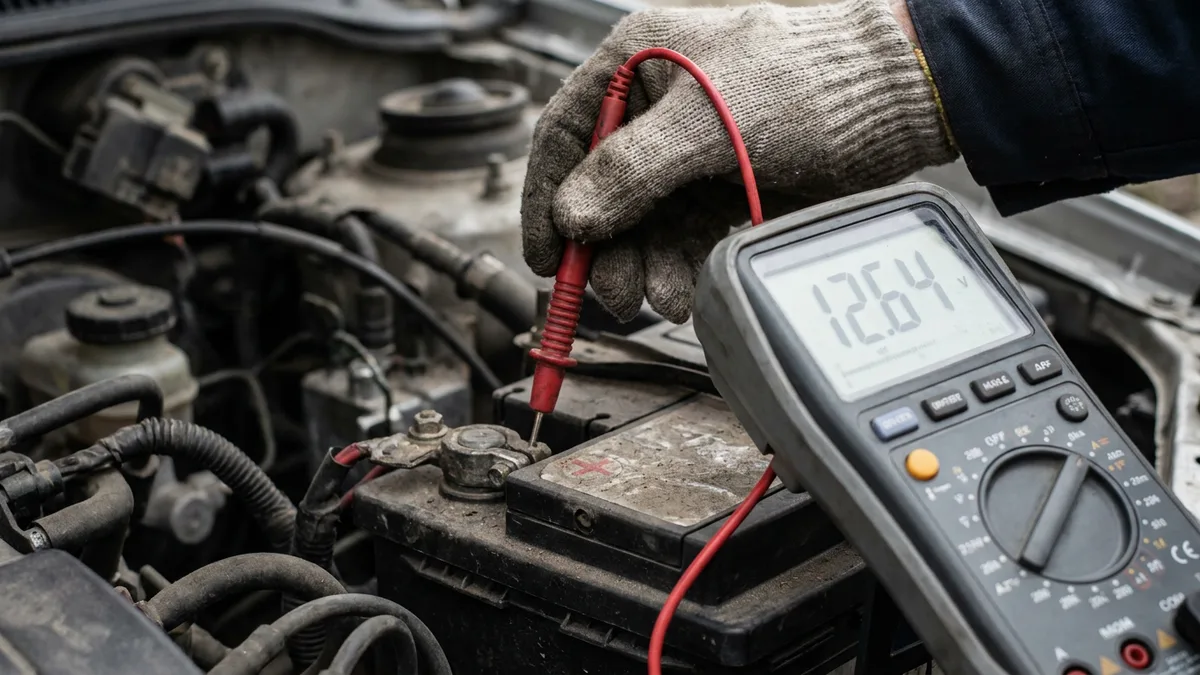
After the visual check, a voltage measurement gives you the first objective data point. For accurate results, the battery must have been resting for at least 30 minutes — no recent driving or attempted starts.
Set a digital multimeter to DC volts (20 V range), touch the red probe to the positive terminal and the black probe to the negative terminal, and read the display.
| Resting Voltage | What It Means |
|---|---|
| 12.6 V or above | Fully charged — healthy starting point |
| 12.4–12.5 V | Slightly discharged — recharge and retest |
| 12.0–12.3 V | Significantly discharged — may have a problem |
| Below 12.0 V | Heavily discharged or failing — test further |
A fully healthy battery at rest reads approximately 12.6 V. If yours is consistently below 12.4 V after a full overnight rest, the battery is either deeply discharged or has lost the capacity to hold a proper charge.
For a complete walkthrough of the multimeter process including the cranking voltage test, see how to test a car battery with a multimeter.
Step 3 — Load Testing (The Real Diagnostic)
Voltage alone doesn’t tell the whole story. A battery can sit at 12.6 V on the bench and fail the moment it has to crank an engine. That’s because internal capacity degrades over time even when surface voltage looks normal — especially after repeated deep discharge cycles in Phuket’s heat.
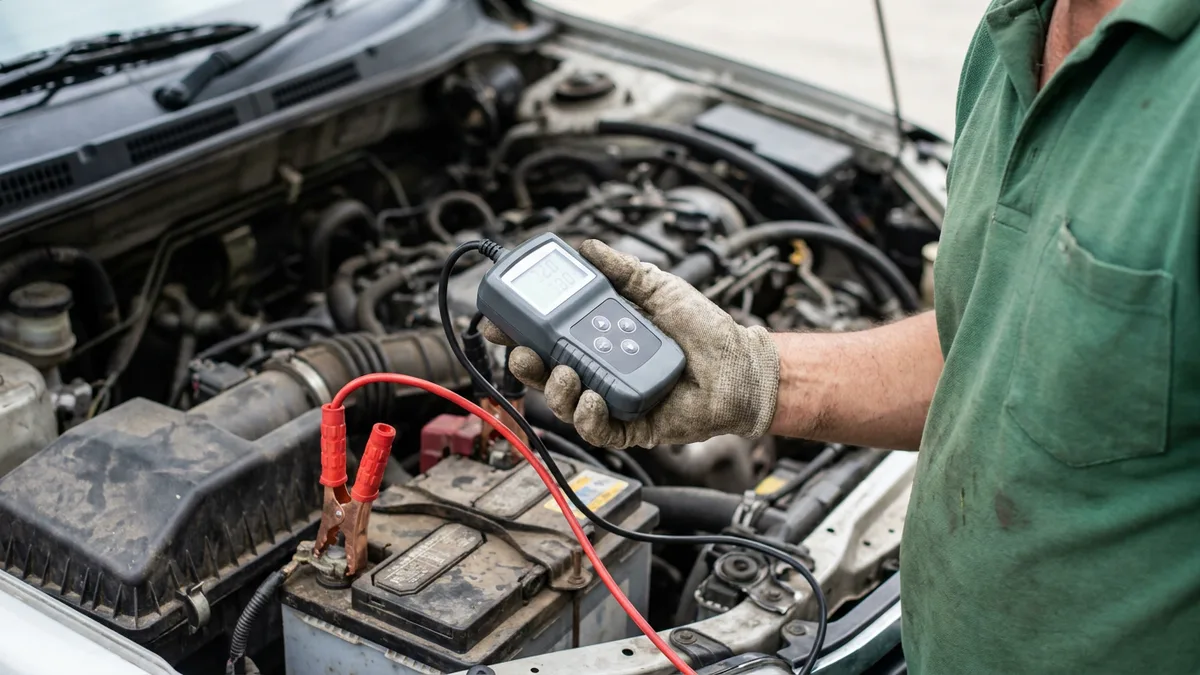
A load test simulates the actual demand of starting the engine. A professional tester draws a current equal to roughly half the battery’s cold-cranking amp (CCA) rating for 15 seconds while monitoring voltage. If voltage drops too far and doesn’t recover, the battery lacks the capacity to do its job reliably.
DIY version — the cranking voltage test: Connect your multimeter probes as described above, then have someone crank the engine while you watch the reading. Voltage will drop during cranking — that’s normal. The key numbers:
- Above 9.6 V during cranking — the battery is delivering adequate current.
- Below 9.6 V during cranking — the battery is struggling under load.
- Below 8.0 V or very slow cranking — likely at end of life.
The DIY version is useful, but it’s less precise than a calibrated digital load tester. For a definitive result, professional testing is the better call.
Warning Signs That Mean Test Now
Don’t wait for a scheduled check if your car is showing any of these symptoms:
- Slow or labored cranking — the starter motor sounds like it’s dragging through mud instead of spinning cleanly.
- Headlights dim at idle — if lights brighten noticeably when you rev the engine, the alternator is compensating for a weak battery.
- Electrical gremlins — windows that move slowly, infotainment that resets, or accessories that behave erratically can all point to low battery voltage.
- Battery warning light — the red battery icon on your dashboard means the charging system has detected a problem.
- It won’t start after sitting overnight — healthy batteries don’t lose enough charge to prevent starting even after several days parked.
When to Test — Phuket’s Climate Makes This Different
In North America or Europe, a battery test every 12 months is adequate for most drivers. In Phuket, the math changes. At sustained temperatures above 30 °C, lead-acid batteries degrade roughly twice as fast. The standard recommendation here is:
- Every three months if the battery is over 18 months old.
- Immediately after any jump start.
- Before and after the rainy season, when you may park a car unused for days at a time.
- Any time you notice a warning sign from the list above.
Tourists renting a car for a week don’t need to worry — the rental company handles this. But expats and long-stay visitors who own or regularly use a vehicle in Phuket should treat three-month checks as routine, not optional. See our guide to car battery care in a tropical climate for a full seasonal maintenance calendar.
What Professional Testing Adds
A professional digital battery analyzer — the kind we carry on every service vehicle — goes well beyond voltage. It measures:
- Actual cold-cranking amps (CCA) vs. rated CCA — tells you how much capacity the battery has lost.
- Internal resistance — rising resistance is an early sign of plate degradation that hasn’t yet shown up in voltage.
- State of health (SOH) percentage — a single number (e.g., 68%) that summarizes overall condition.
- Pass/fail with a printed record — useful if you’re deciding whether to buy a used car.
The tester produces a digital report in about 90 seconds, including a clear recommendation: good, charge and retest, replace soon, or replace now.
How Battery Fast Phuket Can Help
Our battery testing service is mobile, available 24/7, and comes to you — your hotel, your condo car park, the beach road, wherever you are on the island. The test is free. If the result shows you need a replacement, we carry a full range of batteries in our service vans and can swap one in on the spot, typically in under 20 minutes.
If you’re uncertain about your battery’s condition, the easiest next step is to call or message us for a free mobile health check rather than wait until a difficult moment to find out the answer.