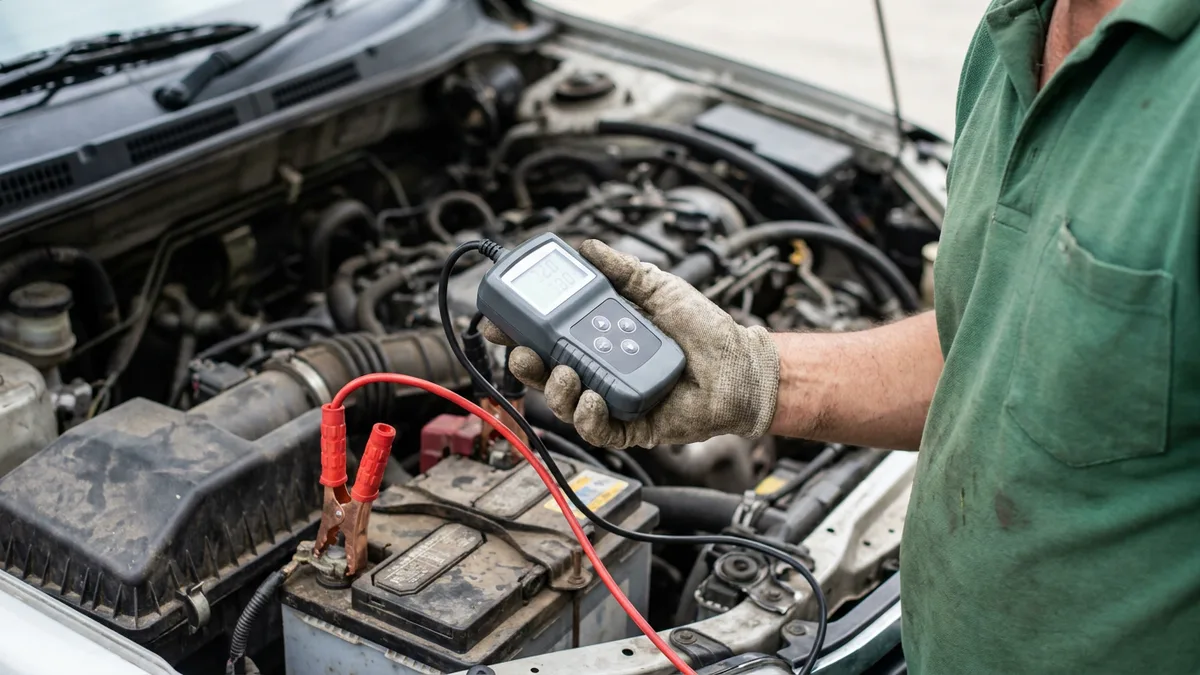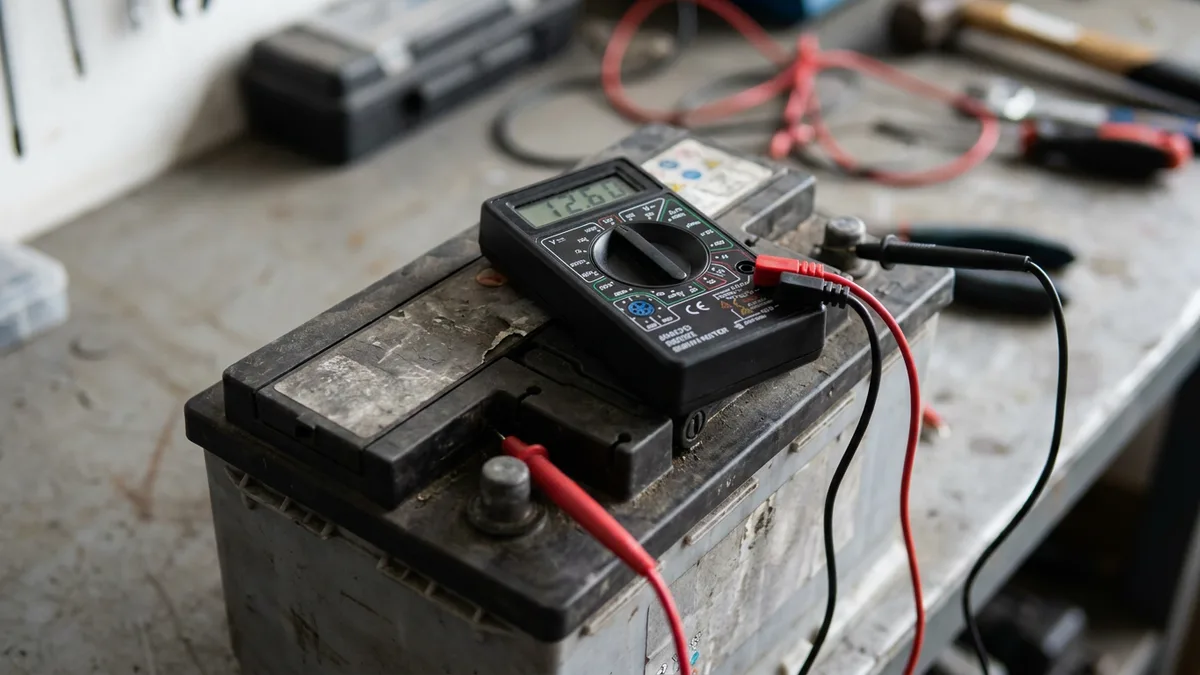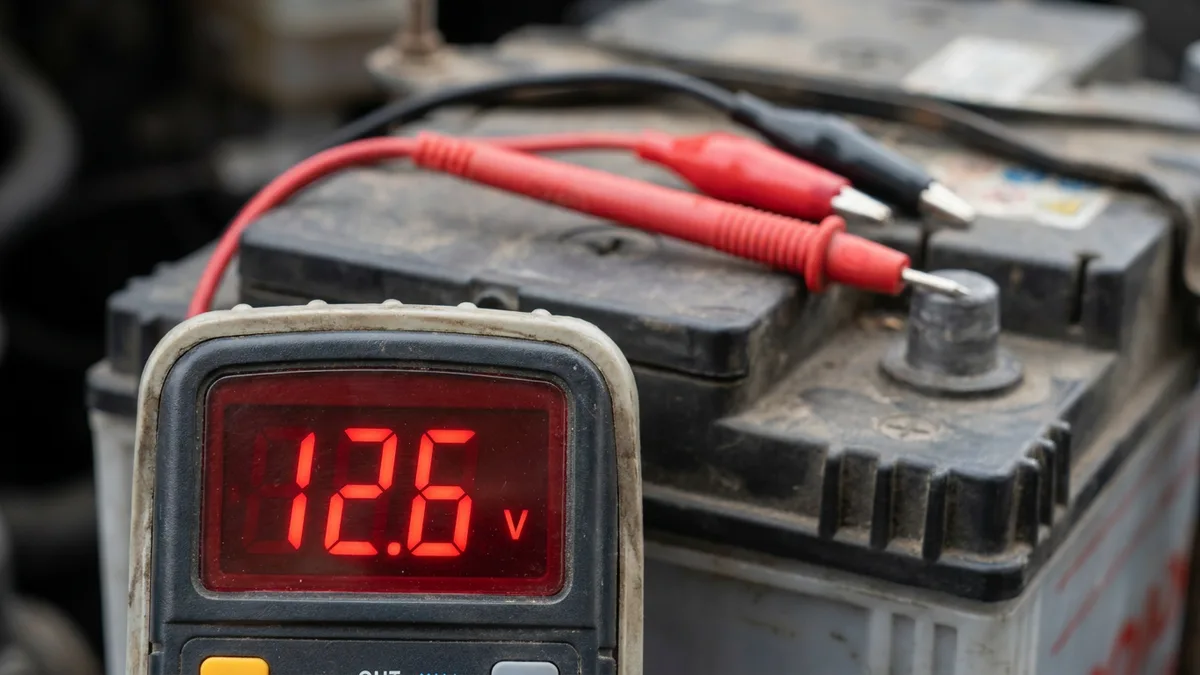
The quick answer: a standard car battery is 12.6 volts when fully charged and sitting at rest. When the engine is running and the alternator is charging it, system voltage rises to 13.7–14.7 volts. During cranking, voltage drops temporarily — anything above 9.6 V during that event is considered acceptable.
Those three numbers — 12.6, 13.7–14.7, and 9.6 — are the benchmarks every driver should know. The first time you open your hood with a multimeter and see something unexpected, this guide explains what it means and what to do next.
Why Your Battery Says “12V” but Reads 12.6V
Car batteries are grouped by nominal voltage, which is a conventional label, not a precise measurement. A “12V” battery is one that uses six lead-acid cells connected in series. Each cell produces approximately 2.1 volts at full charge, giving a total of 12.6 volts for the full pack.
The “12V” designation exists to distinguish this type from other battery systems:
- 6V batteries used in classic motorcycles, older agricultural equipment, and some vintage vehicles
- 24V systems common in heavy trucks, buses, and construction machinery
- 48V mild-hybrid architectures now appearing in newer European and Japanese cars
So when someone asks “how many volts is a car battery,” the most precise answer is: nominally 12 V, but actually 12.6 V when fully charged.
This distinction matters because a battery reading exactly 12.0 V is not “12V full” — it’s approximately 25% charged and probably won’t start the car reliably. Many drivers see “12-something” on a multimeter and assume the battery is fine, when in reality 12.0 V is a warning sign.
The Key Voltage Numbers at a Glance
| Condition | Voltage | What It Means |
|---|---|---|
| Resting, fully charged | 12.6 V or above | Battery is healthy and fully charged |
| Resting, partially charged | 12.2–12.5 V | Some charge, but not full |
| Resting, discharged | Below 12.0 V | Flat — needs charging or replacement |
| Engine running (charging) | 13.7–14.7 V | Alternator working correctly |
| During cranking (starting) | Above 9.6 V | Battery delivering adequate current |
| During cranking (weak) | Below 9.6 V | Battery struggling under load |
These benchmarks apply to a conventional flooded lead-acid battery, which is the most common type in Thailand. AGM batteries — found in many modern stop-start vehicles such as newer Toyota Fortuners, European sedans, and some Japanese hybrids — sit slightly higher at rest, around 12.8–12.9 V when fully charged.
What “Resting Voltage” Actually Tells You
Resting voltage (also called open-circuit voltage) is measured when no current is flowing in or out of the battery. For the reading to be accurate, the battery must have been idle for at least 30 minutes after the engine was last run. The alternator pushes a charge into the battery when the engine is running, which temporarily inflates the surface voltage and gives a misleadingly high reading if you measure right after parking.
Resting voltage tells you how much energy is stored. It does not tell you whether the battery can deliver that energy under the load of starting an engine. That’s a different question, and the answer requires a different test.
A battery with 12.6 V at rest might start the car perfectly or fail on the first hot afternoon, depending on its internal condition. The resting voltage is always the first step, not the final verdict.
What Cranking Voltage Tells You
When the key is turned to start, the starter motor draws a massive surge of current — often 200–400 amps for a fraction of a second. During that event, battery voltage drops sharply. How sharply tells you a great deal about the battery’s true condition:
- 9.6 V or above during cranking: The battery is delivering adequate current. This is the passing threshold.
- 9.0–9.5 V during cranking: Marginal. The car may start today, but the battery is working harder than it should be.
- Below 9.0 V: The battery is seriously struggling. It may still start the engine, but it’s living on borrowed time — and in Phuket’s afternoon heat, when engine-bay temperatures make the oil more viscous and cranking demands increase, it may not start at all.
You can check this with a multimeter by connecting the probes to the battery terminals and watching the display as someone cranks the engine. The lowest number you see during the crank is the number that counts.
What Running Voltage Tells You
Once the engine is running, the alternator takes over as the primary electrical source. The voltage you read at the battery terminals while the engine runs is essentially the alternator’s output voltage. This should be 13.7–14.7 V for a healthy charging system.
- Below 13.5 V while running: The alternator isn’t producing enough output to charge the battery properly. Over time, the battery will slowly drain even while driving.
- Above 14.8 V while running: The voltage regulator may be overcharging the battery. This generates excess heat inside the battery, accelerates water loss in flooded batteries, and significantly shortens battery life — a serious concern in Phuket’s already-warm climate.
Running voltage outside the normal range is a charging system problem, not a battery problem per se. But a charging system that runs too low will kill a battery over weeks. A system that runs too high may kill it in months.
How to Check Your Battery’s Voltage
All you need is a digital multimeter — available for 200–400 THB at any hardware shop, Makro, or Global House in Phuket. Set it to DC volts (20 V range), touch the red probe to the positive (+) terminal and the black probe to the negative (−) terminal, and read the number.
The process takes about 30 seconds once you’ve waited for the battery to rest. Many drivers keep a multimeter in the boot — it’s one of the most useful tools for any car owner.
For the complete step-by-step test including the cranking voltage check, see how to test a car battery with a multimeter. For a full state-of-charge chart with every voltage level mapped to a percentage, the car battery voltage explained guide goes into greater detail with additional context on AGM batteries and temperature effects.
How Phuket’s Heat Changes the Picture
Thailand’s tropical climate complicates battery voltage readings in a few specific ways that drivers from cooler countries may not expect:
Temperature inflates open-circuit voltage slightly. A battery sitting in 35 °C ambient heat may read 12.7 V when it’s actually closer to 90% charge — not 100%. This means a battery that looks healthy on a hot afternoon might behave differently after cooling overnight. Professional testers apply automatic temperature compensation; a basic multimeter does not.
Heat accelerates self-discharge significantly. A battery left parked in direct Phuket sun for three days — common when tourists rent scooters and leave their car at a resort — can lose enough charge to read 12.1 or 12.0 V, even with no electrical fault. This isn’t necessarily battery failure. Charge it fully and re-test before concluding anything.
Heat shortens battery life to 2–3 years from the 4–5 years typical in temperate climates. A battery over two years old in Phuket deserves a load test even if the voltage looks fine, because internal capacity can degrade without the resting voltage showing a dramatic change until close to the end.
When the Voltage Reading Signals Trouble
A single low reading isn’t always cause for alarm. A pattern of low readings is. Signs that voltage is telling you something important:
- Resting voltage below 12.4 V after a full overnight charge — the battery isn’t holding charge.
- Resting voltage above 12.6 V but the car cranks slowly — internal capacity has degraded despite good surface voltage.
- Running voltage below 13.5 V on a car that starts fine — the alternator is undercharging, and the battery will slowly drain over weeks.
- Battery voltage that drops below 12.0 V within 24 hours of charging — sulfation or cell damage.
If any of these patterns describe your situation, our battery testing service will give you a definitive load-test result in under two minutes, wherever you are on the island. We’re available 24 hours a day, come to you, and carry replacement batteries in the van if the test confirms one is needed. A free check is always the simplest next step when the numbers aren’t adding up.