Your car starts fine on Monday, and by Thursday afternoon it’s dead in a hotel car park. In Phuket’s heat, that’s not bad luck — it’s chemistry. High temperatures accelerate the internal corrosion inside a lead-acid battery and speed up self-discharge, so a battery that tested fine three months ago can be nearly finished today. Knowing how to test a car battery with a basic multimeter gives you a clear, objective number instead of a vague feeling that something might be wrong.
This guide walks you through the full process: setting up your meter, reading the resting voltage, performing a cranking test, and interpreting what the numbers actually mean. You don’t need to be a mechanic — just someone who prefers to know rather than guess.
What You Need Before You Start
The only tool required is a digital multimeter set to DC voltage (marked as DCV or V— on most meters). A basic model costs 200–400 THB at any Makro or hardware shop in Phuket and is accurate enough for battery work. You do not need a “smart” battery tester, although those give more detail.
Safety first:
- The battery terminals are not dangerous to touch with bare hands at 12 V, but always keep sparks away from the battery because charging produces hydrogen gas.
- Remove rings and metal watchbands before leaning over the engine bay — a metal bracelet bridging the positive terminal and a ground can cause a serious burn.
- Perform the test in the shade. A bonnet left open in direct Phuket sun will heat the battery and skew your readings slightly.
Step 1 — Let the Battery Rest
This is the step most people skip, and it produces the most misleading results. If you just drove the car or recently attempted to start it, wait at least 30 minutes before taking a voltage reading. The “surface charge” from the alternator or a jump start will make the battery look better than it is.
For the most accurate resting measurement, a two-hour wait is ideal. Overnight is even better if you can plan ahead.
Step 2 — Connect the Multimeter
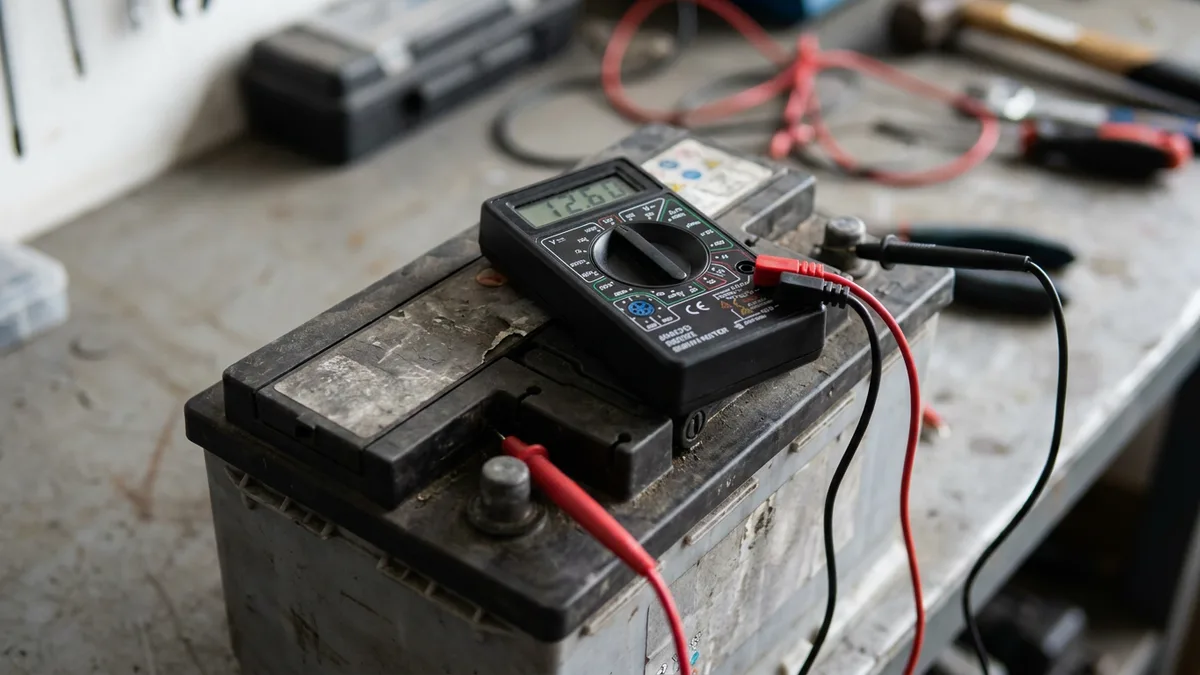
- Set the multimeter dial to DC Volts (20 V range) — or select “auto range” if your meter has it.
- Plug the red probe into the V/Ω port and the black probe into the COM port.
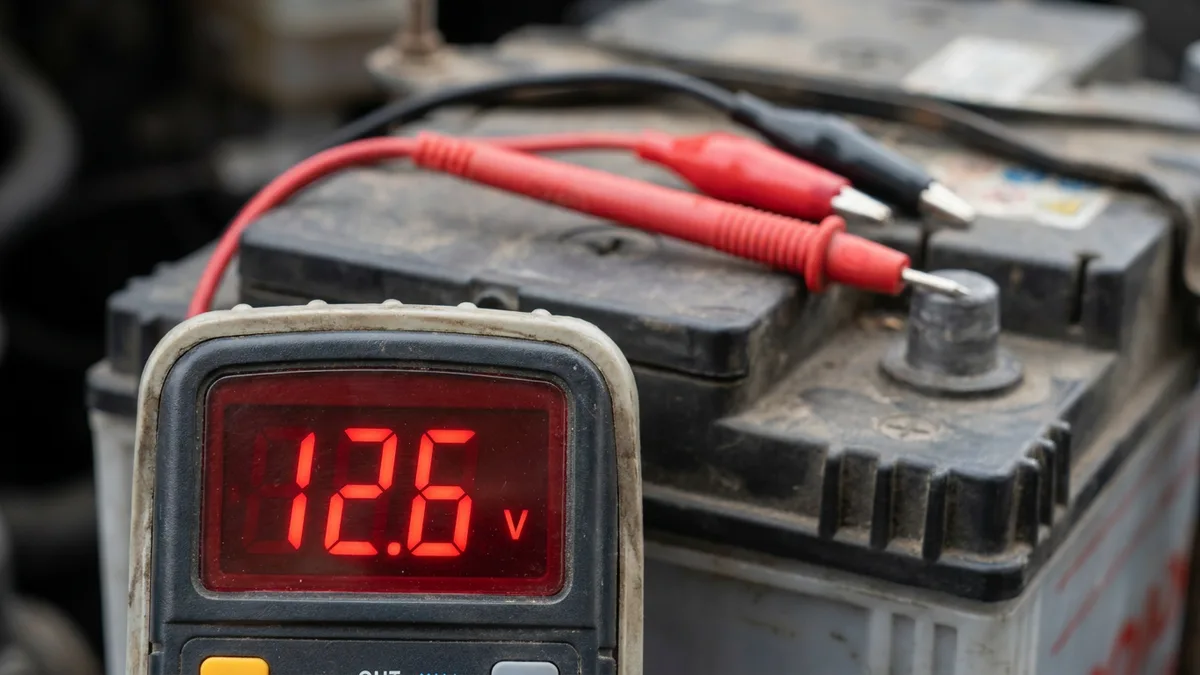
- Touch the red probe to the positive (+) terminal and the black probe to the negative (−) terminal. Do not press hard; a light contact is all you need.
- Read the number on the display.
If you get a negative reading, you have the probes reversed. Swap them and re-read.
Step 3 — Read the Resting Voltage (State of Charge)
Use the table below to interpret the number your meter shows. These values assume the battery has been resting for at least 30 minutes at a temperature around 20–27 °C (68–80 °F) — typical for a shaded spot in Phuket.
| Resting Voltage | State of Charge | What It Means |
|---|---|---|
| 12.6 V or higher | 100% | Fully charged, healthy |
| 12.4 V | ~75% | Slightly discharged — charge it |
| 12.2 V | ~50% | Half flat — needs charging soon |
| 12.0 V | ~25% | Heavily discharged — charge immediately |
| Below 11.8 V | Near 0% | May be failing or deeply sulfated |
A reading at or above 12.6 V is what you want. If yours is below 12.4 V after a full overnight rest, the battery is not holding charge properly and deserves closer attention.
Step 4 — Perform the Cranking Voltage Test
The resting test only tells you the voltage when nothing is demanding current. The cranking test reveals how the battery holds up under the massive load of starting the engine — which is the real job it has to do.
- Have a second person sit in the driver’s seat, or use the remote start.
- Keep your meter probes on the terminals as before.
- Ask your helper to crank the engine (turn the key to start) while you watch the meter display.
- Note the lowest voltage shown during cranking.
During a healthy crank, voltage will dip — that’s normal. What you’re watching for is how far it drops:
- 9.6 V or higher during cranking — battery is delivering adequate current; likely good.
- Below 9.6 V during cranking — the battery is struggling. This is a classic sign of a weak or aging battery.
- Below 8.0 V or the engine barely turns — the battery is likely at the end of its life.
Step 5 — Check the Charging Voltage (Engine Running)
While the engine is running, leave the probes connected and read the voltage again. A working alternator should push the battery voltage up to between 13.7 V and 14.7 V. This tells you the charging system is working.
- Below 13.5 V with the engine running — the alternator may not be charging properly.
- Above 14.8 V — the voltage regulator may be overcharging, which shortens battery life significantly in an already hot climate.
If the resting voltage is fine but the running voltage is out of range, the problem is the alternator, not the battery itself. Our guide on battery vs. alternator faults walks through how to tell the difference.
How Heat Affects Your Readings
In Phuket, ambient temperatures regularly exceed 33 °C. Heat causes a small upward shift in open-circuit voltage — a warm battery might read 12.7 V when it’s really only at 90% charge. This is why professionals use a temperature-compensated tester rather than a basic multimeter for final diagnosis. Still, a multimeter catches the obvious problems: anything below 12.0 V at rest is bad regardless of temperature.
The bigger concern in a tropical climate is that heat accelerates water loss from the electrolyte inside the battery and speeds up plate corrosion. A battery in Phuket typically lasts two to three years, half the lifespan you’d expect in a temperate climate. For a deeper look, see why car batteries die faster in Phuket’s heat.
When a Multimeter Isn’t Enough
A multimeter measures voltage, not actual capacity. A battery can show 12.6 V at rest and still fail to crank the engine because its internal capacity has degraded — especially after deep discharge cycles or years of tropical heat.
A professional load test applies a controlled current draw equal to roughly half the battery’s cold-cranking amp (CCA) rating for 15 seconds and watches the voltage response. That test reveals capacity problems that a simple voltage check misses entirely.
If your resting voltage reads 12.2 V or lower, or the cranking voltage drops below 9.6 V, it’s time to move beyond the multimeter. Our professional battery testing service includes a full load test and digital printout of the results — and it’s available 24 hours a day, seven days a week, wherever you are in Phuket. We can come to your hotel, villa, or car park.
Interpreting Your Results — A Quick Summary
- 12.6 V resting, 13.7–14.7 V running, stays above 9.6 V cranking → Battery and charging system are in good shape.
- 12.0–12.4 V resting → Partially discharged; charge it and re-test. If it won’t hold the charge, replace it.
- Below 12.0 V resting → Likely failing; get a professional load test.
- Cranking voltage below 9.6 V → Battery is weak regardless of resting voltage; plan for car battery replacement soon.
- Running voltage below 13.5 V → Suspect the alternator, not just the battery.
A five-minute multimeter test costs nothing but a little time and can save you hundreds of baht in roadside recovery fees — and the considerable stress of being stranded on the way to Kata Beach. If you’d rather have a certified result and a professional recommendation, give us a call or send a message; we’ll come to you.