Replacing a car battery is not a high-risk job, but it does involve materials that demand a little respect: sulfuric acid, hydrogen gas, heavy lead, and — in modern vehicles — sensitive electronics that don’t respond well to sudden power loss. Knowing how to replace a car battery safely means understanding these hazards clearly, taking simple precautions, and knowing the handful of situations where the job is better left to a professional.
This guide focuses on the safety side of the replacement process. If you want the full step-by-step mechanical walkthrough, see our companion guide on how to change a car battery. Here, we dig deeper into the risks and how to handle them properly.
Understanding the Hazards Before You Start
Sulfuric Acid
A standard lead-acid car battery contains a solution of sulfuric acid and water (the electrolyte). The acid concentration is typically 30–50% — strong enough to cause skin burns and serious eye injury on contact.
Under normal circumstances, the acid stays sealed inside the battery. The risk arises if:
- The battery casing is cracked or damaged
- The battery tips over during removal and electrolyte leaks through vents
- You touch or brush the terminals area and then touch your face
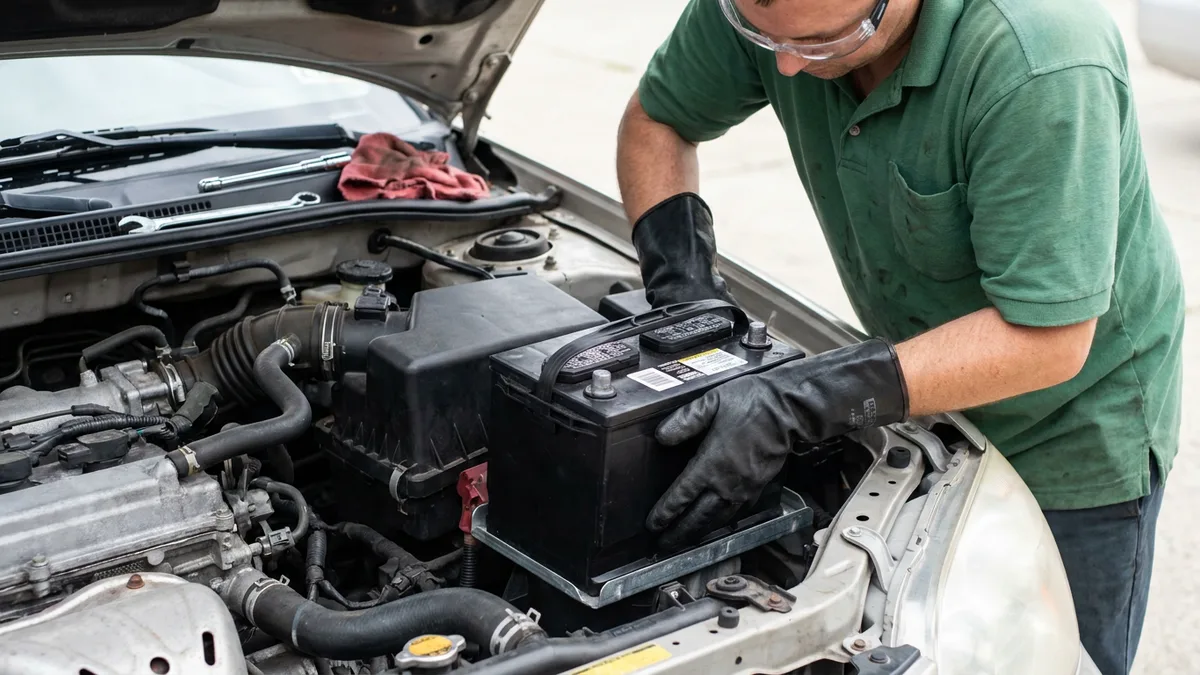
The fix is simple: wear nitrile or rubber gloves and safety glasses throughout the job. This is not optional. It takes five seconds and eliminates virtually all acid risk.
If acid does contact skin, rinse immediately with large amounts of water for at least 15 minutes. If it contacts eyes, rinse urgently with water and seek medical attention — Phuket International Hospital and Bangkok Hospital Phuket both have emergency departments.
Hydrogen Gas
As a battery charges and discharges, it can produce small amounts of hydrogen gas, which is flammable and can accumulate in enclosed spaces. A spark near a hydrogen-rich area around a battery can, in extreme cases, cause ignition.
Practically speaking, the risk is low during a straightforward replacement on a battery that hasn’t just been on a charger. But it’s not zero, so:
- Work in a well-ventilated area — a carport, open garage, or outdoors is ideal. Avoid enclosed spaces.
- No open flames or cigarettes near the battery at any point.
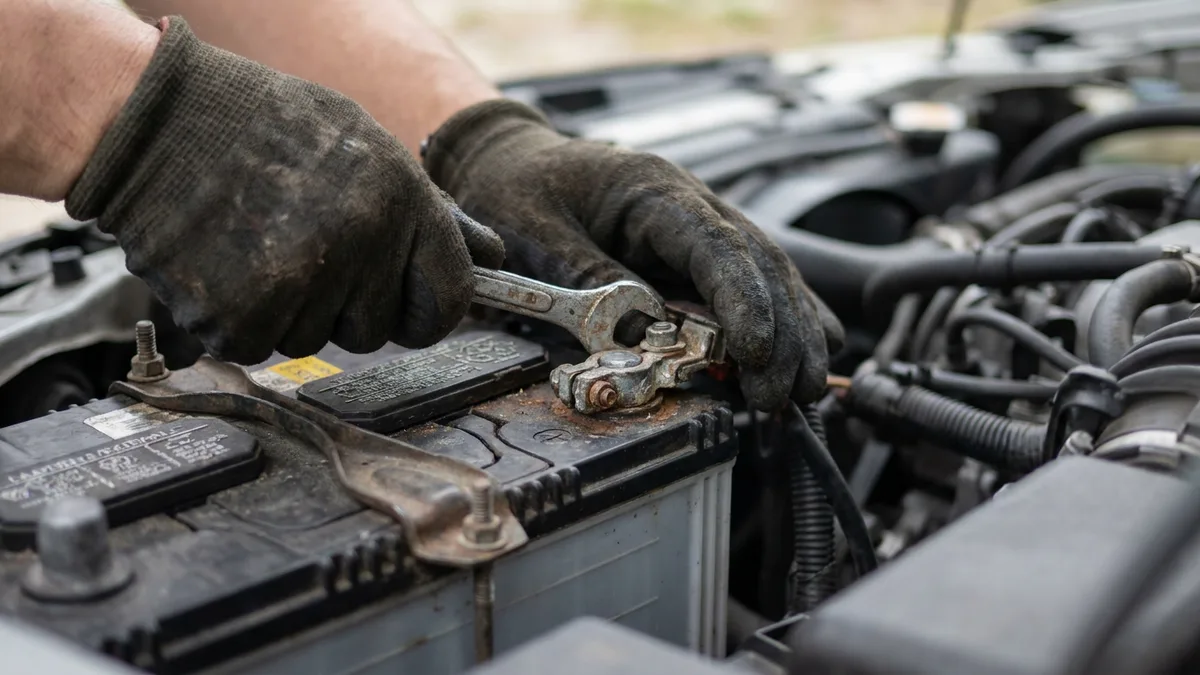
- Don’t short the terminals together — touching both posts simultaneously with a metal object creates a spark and risks igniting any hydrogen present.
- Don’t rest metal tools across the battery top where they could bridge both terminals.
A ventilated outdoor space in Phuket is usually available and makes the hydrogen hazard essentially negligible.
Heavy Weight
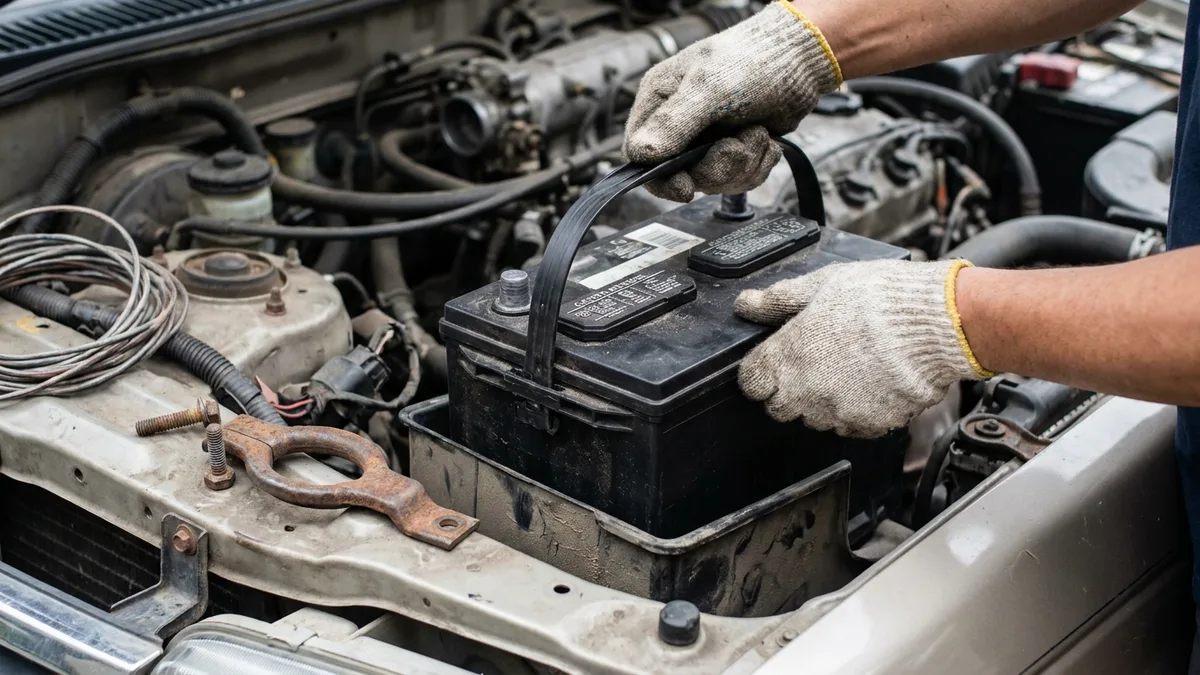
This is the hazard most people underestimate. A standard car battery weighs 12–20 kg — comparable to a large bag of rice. Dropping it on your foot, on the car, or on the ground can cause injury and damage.
Lift with both hands and keep it close to your body. Don’t try to catch a slipping battery. Set it down gently on a flat, stable surface — never balanced on an engine component.
PPE: What to Wear and Why
| Item | Why It Matters |
|---|---|
| Safety glasses or goggles | Protects eyes from acid splash and terminal sparks |
| Nitrile or rubber gloves | Prevents acid contact; also protects from dirty terminal grime |
| Closed-toe shoes | Protects feet if the heavy battery drops |
| Long sleeves (optional) | Useful if the battery is in a tight location with sharp metal edges |
This is not a job that requires specialized equipment — basic safety gear available at any hardware store covers the real risks completely.
ECU and Electronics Safety in Modern Cars
This is the safety area that most DIY guides under-discuss. In a modern car — broadly, anything made after around 2005, and especially anything with stop-start technology, adaptive cruise control, or a complex infotainment system — disconnecting the battery can cause problems that look like electrical faults but are actually just the result of power interruption.
What can happen when battery power is cut:
- ECU adaptive settings reset — the engine management computer “forgets” its learned fuel trim, throttle response, and idle settings, causing rough running or stumbling for a period after reinstallation
- Anti-theft radio lockout — many factory-fitted radios require a PIN code after battery loss; if you don’t have the code, the radio won’t work until a dealer unlocks it
- Power window recalibration — some vehicles require each window to be cycled fully up and down before the one-touch function works again
- Sunroof reset needed
- Clock reset — minor but annoying
- Throttle body relearn — some engines idle badly until a specific driving cycle is completed
How to prevent these issues:
Use a battery memory saver — a small device that plugs into the OBD2 diagnostic port and supplies backup voltage from an AA battery holder or small 12V source. This keeps the car’s systems powered at a low level while the main battery is out, preserving all stored settings.
Memory savers are inexpensive (a few hundred baht at auto parts shops) and genuinely prevent a frustrating post-replacement troubleshooting session. They’re especially worth using on European vehicles, which tend to have the most sensitive ECU configurations.
If you don’t use a memory saver and the car behaves oddly after the new battery is installed:
- Drive normally for 10–20 km — most ECU adaptive settings will re-learn during this period
- Cycle power windows all the way up and down once each
- Set the clock and radio presets manually
- If the engine idles very poorly or throws a warning light, a throttle body relearn procedure may be needed — check your owner’s manual or a marque-specific forum
Special Cautions: Stop-Start and Hybrid Vehicles
If your vehicle has a stop-start system (the engine turns off automatically at traffic lights and restarts when you lift the clutch or release the brake), it almost certainly uses either an EFB (Enhanced Flooded Battery) or AGM (Absorbed Glass Mat) battery — not a standard flooded battery.
Replacing a stop-start vehicle’s battery with a standard flooded battery is a safety and performance mistake. The stop-start system will continue to cycle the battery far harder than a standard battery is designed to handle, leading to premature failure within months. Always replace like-for-like — EFB with EFB, AGM with AGM — or upgrade (never downgrade).
For full hybrid or plug-in hybrid vehicles (Toyota Prius, Honda Jazz hybrid, etc.), there are two batteries: a small 12V auxiliary battery (handled the same as a standard car battery) and a large high-voltage traction battery pack. The 12V auxiliary can be replaced using standard procedures. Do not attempt to service the high-voltage traction battery yourself — this requires specialized training and equipment and is extremely dangerous without it. High-voltage hybrid systems operate at 200–650 volts DC, which is potentially fatal.
Correct Battery Disposal in Thailand
Old car batteries are hazardous waste and must not go into household trash or general recycling bins. Lead contamination and acid leakage are serious environmental hazards, and improper disposal is illegal under Thai law.
In Phuket, your options:
- Return the old battery to the supplier — any legitimate battery shop will take it; many require it as part of the purchase (core charge/deposit model)
- Drop it at B-Quik, Caltex, or similar auto service centers — most accept old batteries free of charge
- Leave it with a mobile battery service — if you use a mobile replacement service like ours, we take the old battery for proper recycling as part of the service
Lead-acid batteries are highly recyclable — nearly 98% of a battery’s materials can be recovered and reused. Responsible disposal matters.
When the Job Calls for a Professional
For most passenger cars, battery replacement is a manageable DIY task with the precautions described above. But certain situations warrant calling a professional:
- Battery in a non-standard location — boot-mounted batteries, under-seat batteries, or batteries hidden behind engine bay panels are significantly more complex to access and replace
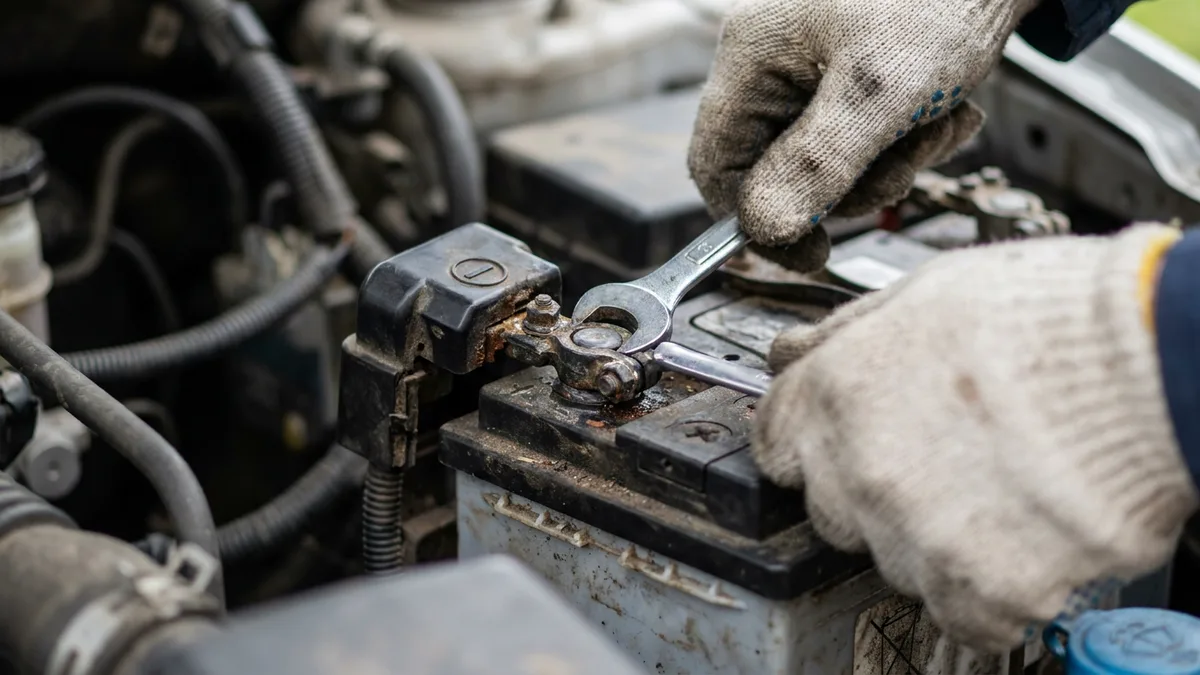
- Severely corroded or seized terminals — forcing a stuck terminal can snap cable ends, causing much larger electrical repairs
- Visible battery damage — a cracked case, swollen housing, or leaking electrolyte means the battery needs to be handled with extra care and the affected area may need cleaning with a neutralizing solution
- Hybrid or EV traction battery — strictly professional territory
- Post-replacement starting failure — if the car still won’t start after a careful installation, the issue may be the alternator, a parasitic drain, or a faulty new battery, not something installation alone will fix
In Phuket, calling a professional isn’t a concession — it’s often the fastest and safest solution. Our car battery replacement service operates 24 hours across the island, brings the right battery to you, handles disposal of the old one, and gets you back on the road without the hassle.
If you’ve done everything right and the car still gives you trouble, a full battery and electrical diagnostic will quickly pinpoint whether it’s the battery, the alternator, or something else entirely.
Safety first doesn’t mean being overly cautious — it means being prepared. With the right gear, the right precautions, and a clear understanding of your vehicle’s specific needs, replacing a car battery is a job you can handle confidently.