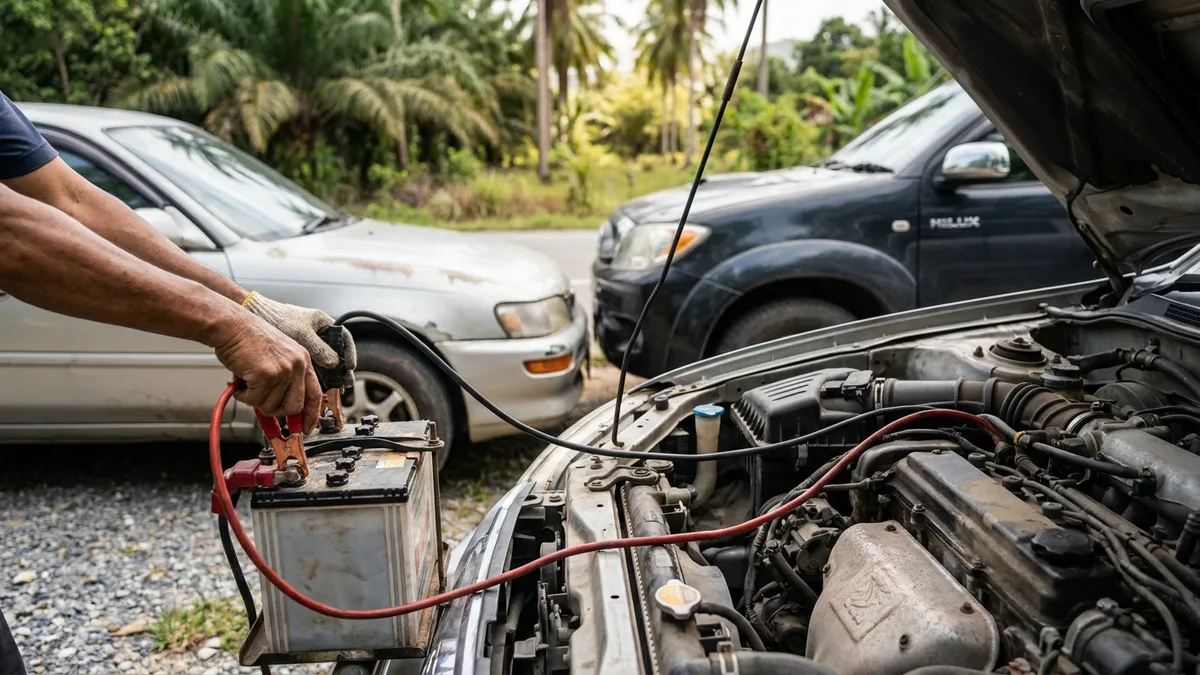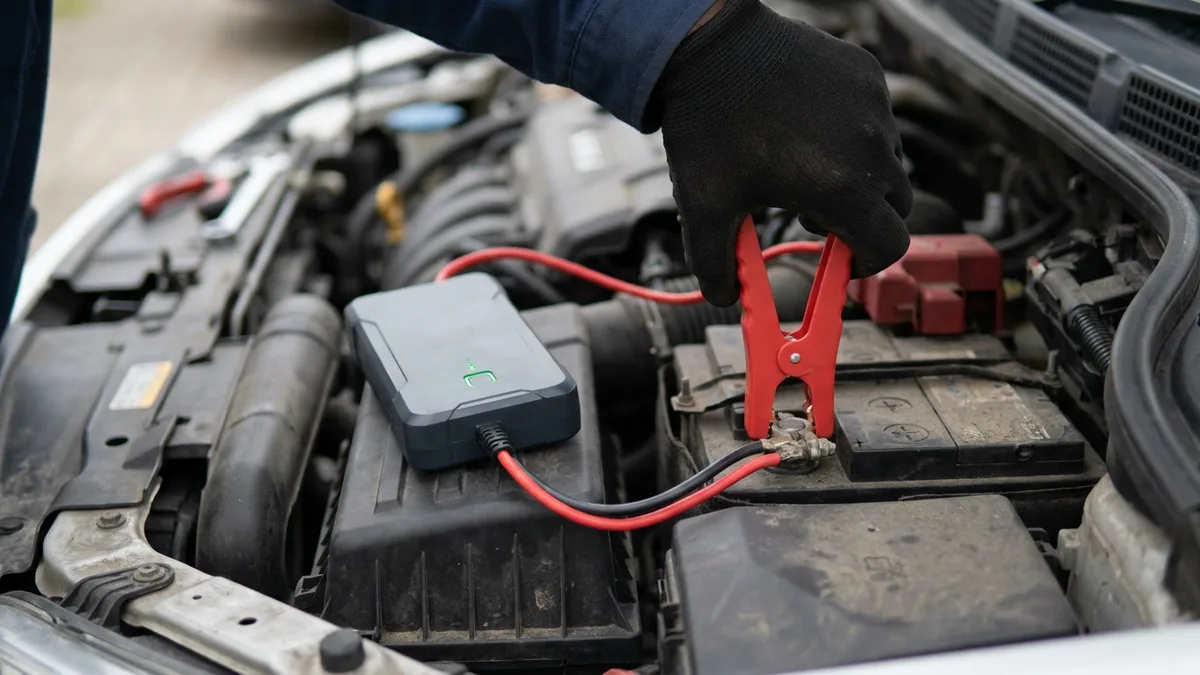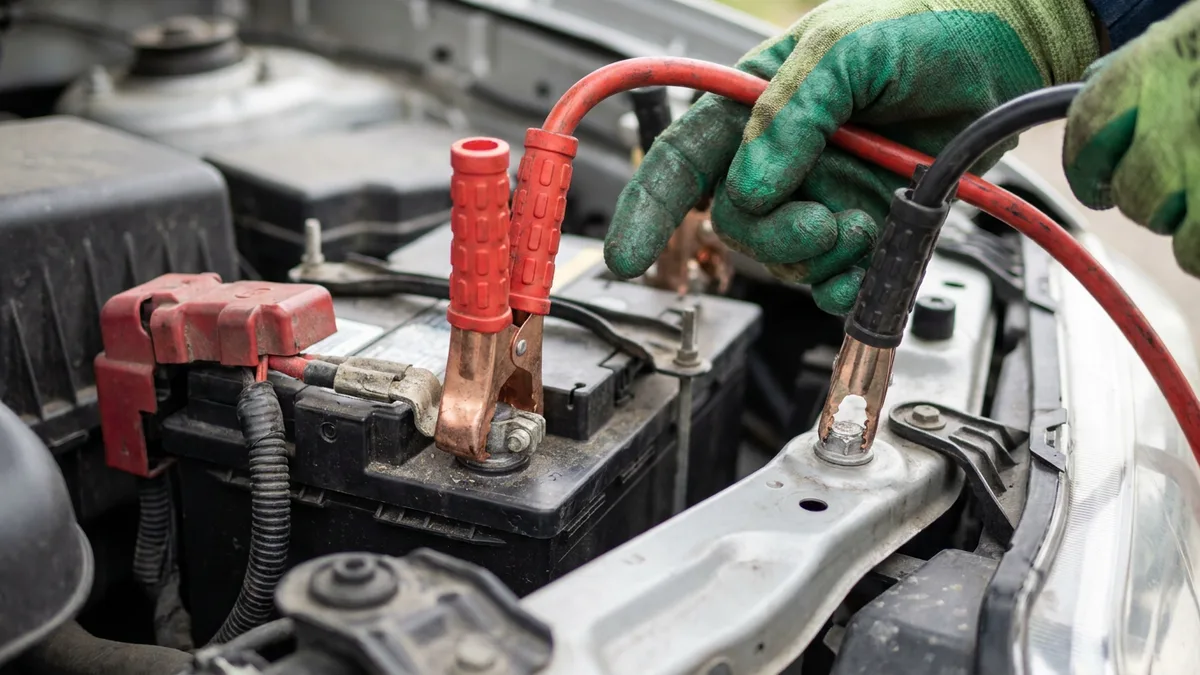
You are in a car park somewhere in Phuket — maybe outside a shopping mall in Phuket Town, a beach car park in Kata, or your hotel lot — and the car is completely dead. A kind stranger pulls alongside and offers a jump-start with cables. You accept gratefully, but then you both stand there staring at the engine bay wondering exactly what goes where.
Connecting jumper cables in the wrong order is one of those mistakes that sounds trivial until it happens to you. Done incorrectly, it can blow a fuse, damage the car’s ECU, or in rare cases cause a battery to rupture. Done correctly, it takes under five minutes and has you back on the road. This guide focuses entirely on the jumper cable method — the specific steps, the correct sequence, what to watch out for on newer cars, and the mistakes that catch people out.
What you need before you start
To jump-start a car with cables you need two things: a set of cables and a donor vehicle with a healthy battery.
Choosing jumper cables:
- Gauge matters. Cable thickness is measured in AWG (American Wire Gauge) — the lower the number, the thicker the wire. For most passenger cars, 4 AWG or 6 AWG cables are adequate. The cheap 12 AWG cables sold at petrol stations are better than nothing but will overheat on larger engines.
- Length matters. 3-metre (10 ft) cables are the minimum. 4–5 metres (12–16 ft) give you flexibility to park the donor car in a practical position without blocking traffic.
- Clamp quality matters. Look for solid copper clamps with good spring tension. Thin stamped-steel clamps can lose grip mid-jump and arc.
Choosing a donor car:
- The donor battery should be the same or higher voltage — 12 V for a standard petrol or diesel car. Do not use a 48 V mild-hybrid as a donor without checking the manual.
- The donor car should be in good working order. A donor with a marginal battery of its own may not deliver enough current.
- Park the donor close enough that the cables reach both batteries comfortably, but make sure the vehicles do not touch metal-to-metal.
Safety checks before touching anything
Take 60 seconds for these checks. They matter.
- Inspect the flat battery. A visibly cracked case, a bulge in the side walls, or acid seeping from the terminals means the battery is unsafe. Do not attempt a jump-start — call for assistance and keep people away from it.
- Check for corrosion. White or blue-green powder on the terminals increases resistance and reduces the effectiveness of the jump. Scrape it off with an old toothbrush or a rag before connecting. Corroded terminals deserve their own attention once you are safe.
- Apply the handbrake on both vehicles and make sure both are in Park (automatic) or in gear (manual).
- Turn both ignitions off. You connect cables to dead cars, not running ones.
- No open flames or smoking. A deeply discharged or damaged battery can off-gas hydrogen, which is flammable.
The correct cable connection sequence
This is the part people get wrong most often. The order is not arbitrary — it minimises the risk of a spark near the battery and protects both cars’ electronics.
Connect in this order:
- Red clamp → flat battery positive (+). The positive terminal is usually larger and marked with a + symbol or the letters “POS”. Connect the red clamp here first.
- Red clamp → donor battery positive (+). Run the other end of the red cable to the donor car’s positive terminal. You now have red cable between the two positive terminals.
- Black clamp → donor battery negative (−). Connect the black clamp to the donor battery’s negative terminal (marked − or “NEG”).
- Black clamp → unpainted metal on the dead car’s engine block. This is the grounding step. Do NOT connect to the dead battery’s negative terminal. Choose a bolt head, a metal bracket, or any bare metal well away from the battery. This placement means any tiny spark when you make this final connection happens at the engine block, not near hydrogen gas.
Disconnect in reverse order:
Once the car is running, remove cables like this:
- Black clamp from the engine block of the previously dead car
- Black clamp from the donor battery negative
- Red clamp from the donor battery positive
- Red clamp from the previously dead car’s positive terminal
Keep both engines running while you disconnect, and do it briskly.
Starting the cars
With cables connected correctly:
- Start the donor car and let it run for two to three minutes at a gentle fast-idle. This gives the flat battery a small initial charge and ensures the donor’s alternator is supplying current.
- Try to start the dead car. If it cranks strongly and fires, great. If it cranks slowly but does not fire, wait two more minutes and try again.
- If it still will not start after three attempts, the battery may be too deeply discharged or too damaged to accept a charge via cables. This is common with old batteries in Phuket’s heat. It is time to call a professional rather than keep trying.
Common mistakes to avoid
| Mistake | Why it matters |
|---|---|
| Connecting red to negative | Instant short circuit; can blow fuses or damage ECU |
| Skipping the engine-block ground | Increases spark risk near the battery |
| Using cables that are too thin | Cables overheat; insufficient current to start large engines |
| Letting clamps touch each other | Short circuit across the donor battery |
| Turning on the donor car before connecting | Reduces control; increases arc risk at connection |
| Removing the cables while ignition is on | Can cause a voltage spike that damages electronics |
| Connecting to a visibly damaged battery | Risk of rupture or chemical burn |
Special considerations for modern cars
Vehicles made in the last decade increasingly use electronics that are sensitive to voltage spikes.
Stop-start (idle-stop) systems: These cars carry AGM (Absorbent Glass Mat) or EFB (Enhanced Flooded Battery) batteries that are managed by a Battery Management System (BMS). When you replace or jump-start these, the BMS needs to recognise the state of the battery. Jump-starting itself is generally safe, but always check the manual for a dedicated jump-start lug, which is often located in the engine bay separately from the physical battery (which may be in the boot or under a seat).
Hybrids and EVs: A hybrid’s 12 V auxiliary battery can be jump-started exactly like a conventional car battery. The high-voltage traction battery is entirely separate and is not involved. Never attempt to jump-start the high-voltage system.
Cars with sensitive infotainment or audio systems: Some premium vehicles recommend a brief ECU reset after a jump-start. Check the owner’s manual.
Fuse boxes: If the jump-start does not work and the car had previously been starting fine, check the main fuse box. A blown main fuse can prevent the car from starting even with good power available.
What to do immediately after the engine starts
Getting it running is step one. Step two is making sure it stays that way.
- Drive continuously for at least 25–30 minutes. The alternator will recharge the battery, but it needs sustained engine speed to do so effectively. A slow crawl through Patong traffic does not cut it — aim for a highway run if you can.
- Avoid high-drain accessories initially. Air conditioning at maximum, rear demister, and headlights all draw significant current. Give the alternator a few minutes before loading it up.
- Get the battery tested the same day. A battery that has been deeply discharged may have suffered permanent damage to its internal plates. A load test — not just a voltage reading — will tell you whether it is worth keeping. Our battery testing service is available across Phuket at any hour.
- If the battery cannot hold a charge, a car battery replacement is the right next step. Driving on a marginal battery in Phuket’s heat is a gamble you will likely lose within days.
When to skip the cables and call instead
Some situations call for a professional rather than a DIY fix with jumper cables. If the battery is damaged, if you have already tried twice without success, if you are not confident about your car’s specific wiring, or if it is the middle of the night in an unfamiliar area — our mobile jump-start service can reach you anywhere on the island around the clock. We carry calibrated jump-start equipment and a full stock of batteries, so if the jump does not hold, we can sort the replacement in the same visit with no second callout needed.
Call or message us on LINE with your location, and we will be with you in roughly 30 minutes.