Picture this: you have just finished a day at Kata Beach, the sun is setting, and you come back to find your rental car completely silent when you turn the key. There is no friendly driver parked next to you with cables, and the car park is half-empty. If you had a portable jump starter sitting in the glovebox, you would already be on your way to dinner. If you did not, you are now making phone calls.
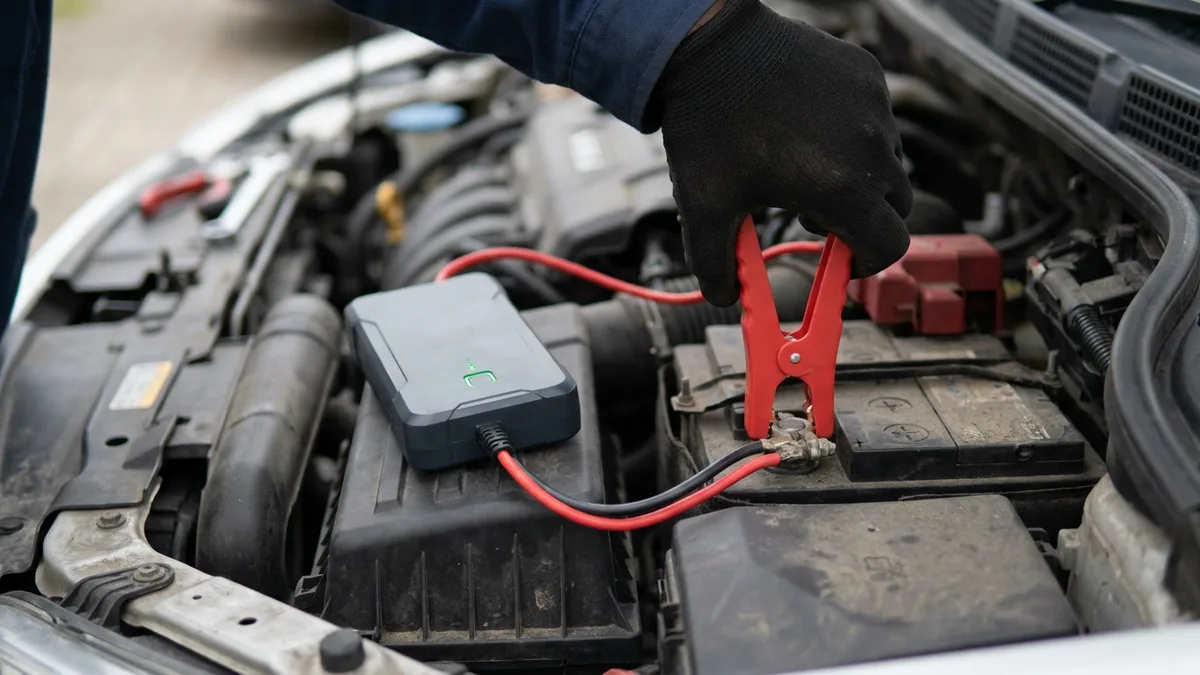
A portable jump starter — also called a jump pack, jump box, or booster pack — is a compact lithium-ion battery unit with built-in clamps that can crank a car engine entirely on its own. No donor car, no waiting for someone to pull alongside you, no awkward cable geometry in a tight car park. Learning how to jump start a car with a battery pack is one of the most practical skills any driver in Phuket can have, especially given that the heat here shortens battery life to two or three years on average.
How a lithium jump starter is different from traditional cables
Older jump-starter packs were lead-acid units — bulky, heavy, and slow to self-discharge. Modern lithium packs changed the category completely.
| Feature | Lithium jump pack | Lead-acid jump pack | Traditional cables |
|---|---|---|---|
| Weight | 0.5–1 kg | 5–10 kg | 0.5–1 kg |
| Size | Fits in glovebox | Needs a boot shelf | Bag in boot |
| Donor car needed | No | No | Yes |
| Charge retention | 6–12 months | 1–3 months | N/A |
| Output | 400–2,000 A peak | 200–600 A peak | Limited by cable gauge |
| USB charging | Most models | Rare | No |
The lithium pack wins on convenience in almost every scenario. The main trade-off is price — a quality unit costs ฿1,500–฿4,000 — but that cost looks reasonable against the alternative of a ฿500 tow truck fee and two lost hours of your holiday.
Choosing the right jump starter for your car
Not all jump starters are equal, and the wrong one simply will not have enough power.
Peak amps: This is the burst current the pack can deliver to turn the starter motor. Use this as a baseline guide:
- 4-cylinder petrol (up to 2.0 L): 400–600 A peak
- 6-cylinder petrol or 4-cylinder diesel: 600–900 A peak
- V8 or large diesel (SUVs, pickup trucks): 1,000–2,000 A peak
Most passenger cars in Phuket — including popular rental models like the Honda City, Toyota Yaris, and Mitsubishi Mirage — are well served by a 600 A pack. If you drive a Ford Ranger or a large SUV, step up to at least 1,000 A.
Battery capacity (mAh): The capacity determines how many jump attempts you can make before the pack needs recharging. A 12,000 mAh pack typically delivers three to five jumps. Higher capacity is better if you sometimes lend it to friends or go on long road trips.
Safety features to look for:
- Reverse polarity protection (alerts or refuses to fire if clamps are connected backwards)
- Over-current protection
- Short-circuit protection
- LED torch (useful at night on a dark road)
Brands like NOCO, Tacklife, and Gooloo are well-reviewed and widely available online in Thailand.
Step-by-step: using a portable jump starter
This is simpler than using cables with a donor car, but the sequence still matters.
Before you start
- Check the pack’s charge level. Every jump starter has a charge indicator. If it shows less than two bars, the pack may not deliver enough current for a successful start. Charge it before relying on it.
- Inspect the flat battery for visible damage — cracks, bulging, or leaking acid. If you see any of these, do not proceed. A damaged battery can vent gas and is not safe to boost.
- Turn the car ignition off. The jump pack should connect to a car that is not trying to crank.
Connecting the pack
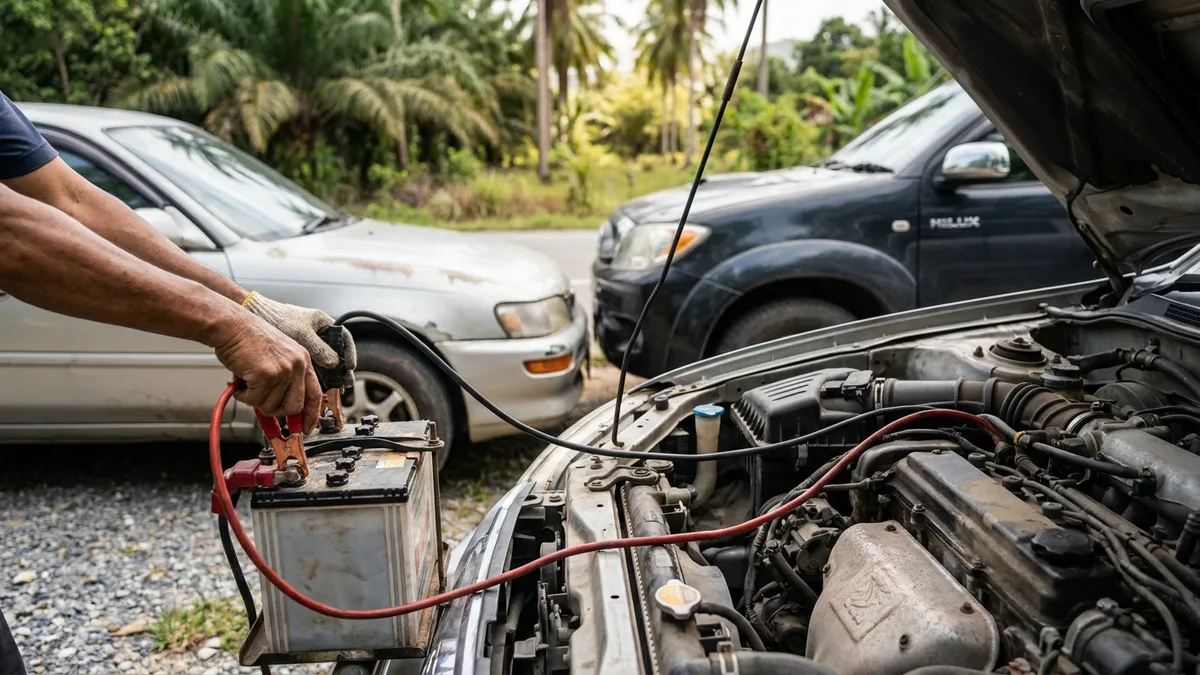
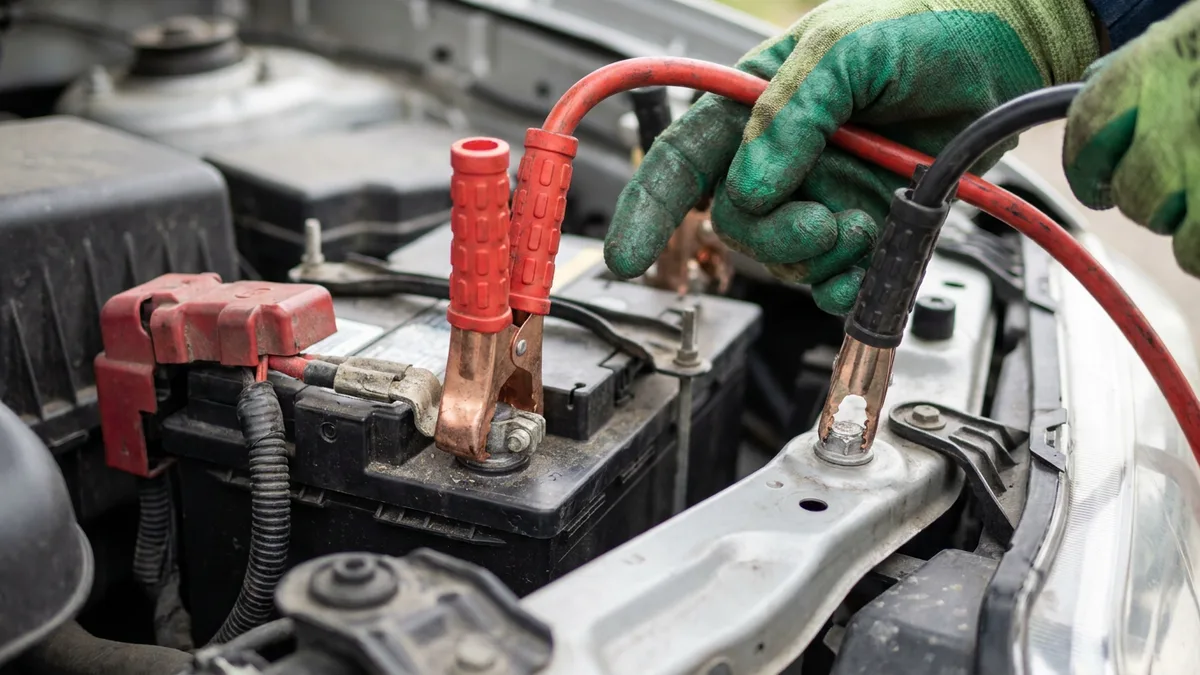
- Connect the red clamp to the positive (+) terminal on the flat battery. The positive terminal is usually larger and marked with + or “POS”. Make sure the clamp has a firm, clean grip on bare metal — not on corrosion crust.
- Connect the black clamp to an unpainted metal surface on the engine block — a bolt, bracket, or engine mount. This is the grounding point. Some packs come with instruction to connect directly to the negative battery terminal, but grounding to the engine block is safer because any small spark at connection happens away from the battery.
- Switch the jump starter on. Most units have a power button; some have a safety interlock that you press and hold for two seconds before the pack activates. The LED indicator should show green or ready.
Starting the car
- Wait 30 seconds. Let a small trickle reach the battery. This also gives the pack’s electronics time to stabilise.
- Attempt to start the car. If it fires immediately, great. If it cranks slowly but does not start, wait another 60 seconds and try once more.
- Do not make more than three attempts in a row. Rapid repeated attempts overheat the pack and stress the starter motor. If three tries with reasonable pauses between them do not work, the issue is likely beyond a flat battery. See our guide on what to do when your car won’t start for the next diagnostic steps.
Disconnecting safely
- Once the engine is running, switch the jump starter off before disconnecting.
- Remove the black clamp first (from the engine block), then the red clamp from the positive terminal.
- Stow the pack. Coil the cables neatly and tuck the pack away.
After a successful jump-start
Starting the car is not the end of the story. In Phuket’s heat, a battery that needed a boost is usually one that is already in decline.
Drive for at least 25–30 minutes continuously. The alternator recharges the battery while the engine runs, but short stop-start driving in Patong traffic is not enough. A run along a longer road at steady speed is ideal.
Get the battery tested promptly. A battery that has been deeply discharged may have degraded internally even if it holds charge after a long drive. Our battery testing service can check the battery’s true capacity under load and tell you whether it is worth keeping.
If the test shows the battery is at the end of its life, a car battery replacement is the next step. Continuing to drive on a marginal battery in Phuket’s heat is a gamble — you may get away with it for a week, or you may be stranded at the roadside in the middle of the night.
Why every Phuket driver should keep one charged
Phuket’s combination of extreme heat, high humidity, and driving patterns that include a lot of short trips creates a uniquely punishing environment for car batteries. Two years is a realistic lifespan for many standard batteries here. That means at some point — probably when you least expect it — you or someone you are travelling with will face a flat battery.
If you know the signs your battery is dying you can often get ahead of it. But even with a new battery, a jump pack is cheap insurance. It also helps other drivers. Plenty of tourists in Phuket have no idea that a jump pack exists, and pulling one out of your glovebox and getting a stranger moving in three minutes is an act of genuine kindness that costs you almost nothing.
A charged jump pack stored in a cool part of your car — not in the direct sun in the boot — will retain useful charge for six months or more with a modern lithium unit. Check it every time you service the car.
When a pack is not enough
A jump pack solves a flat battery. It does not solve a failing alternator, a bad starter motor, a fuel issue, or a battery that is so degraded it cannot hold charge for more than a minute. If you jump-start the car, drive for 30 minutes, and come back to a dead battery again, the battery itself needs replacing.
If you are in Phuket and the pack is not solving the problem, our 24-hour mobile service can reach you across the island. We carry professional jump equipment and a full stock of replacement batteries — so whatever the cause, we can diagnose it and sort it in one visit. Send us your location on LINE and we will be with you shortly.