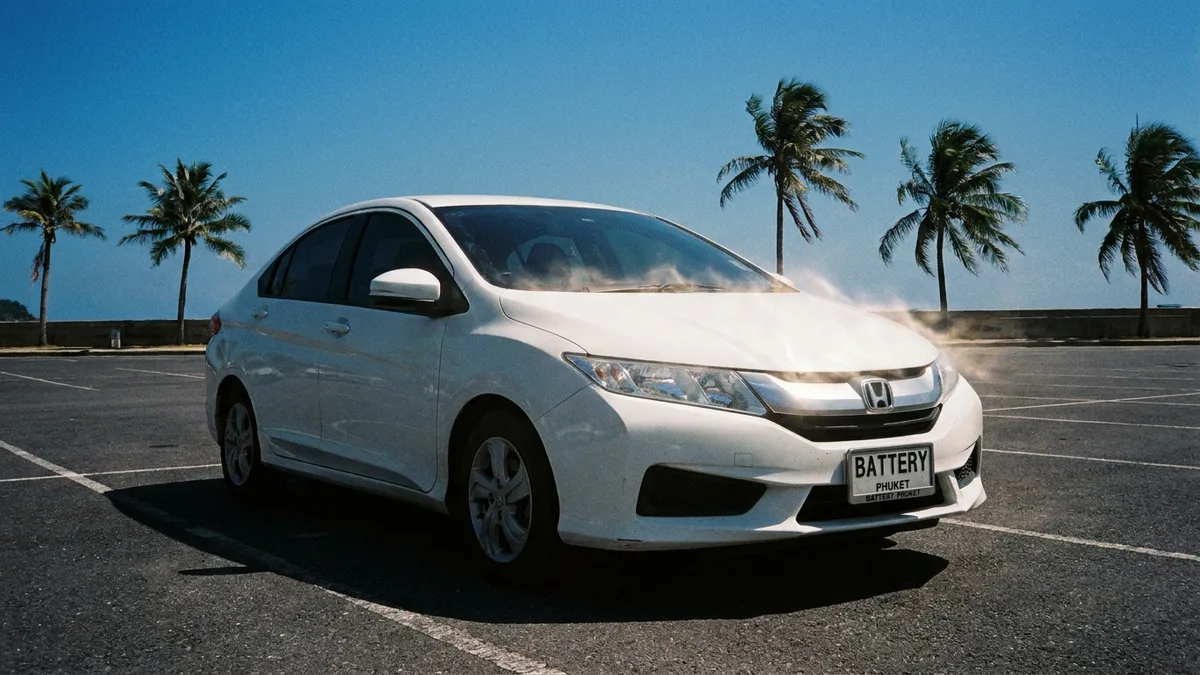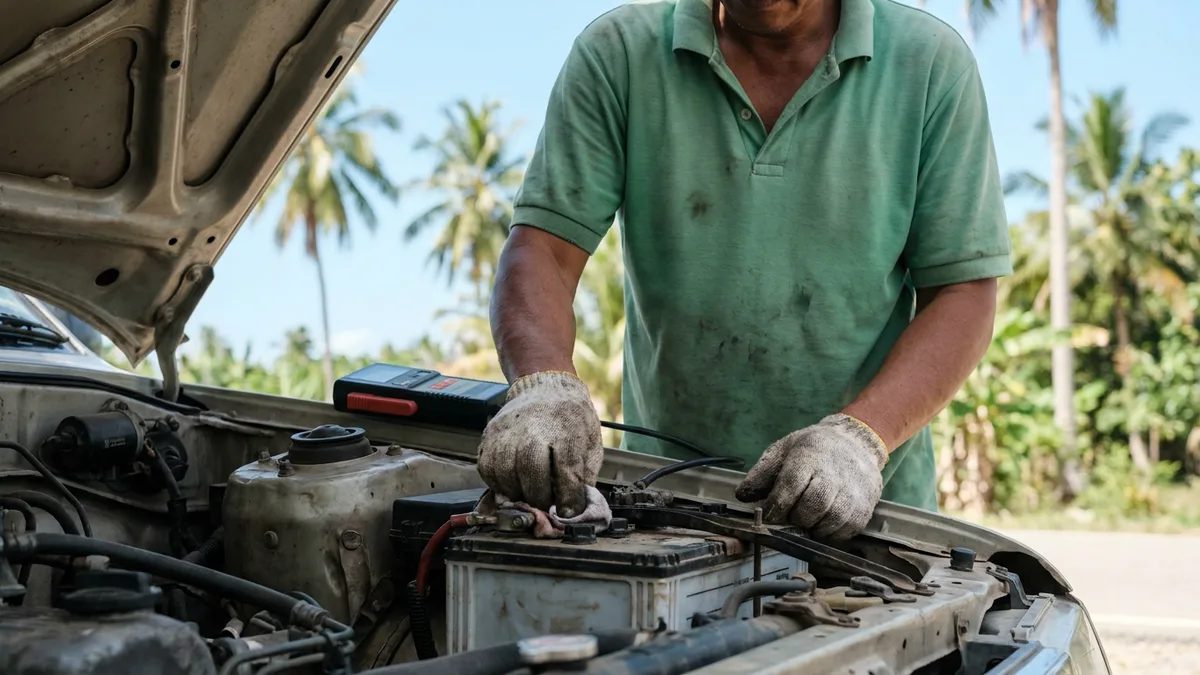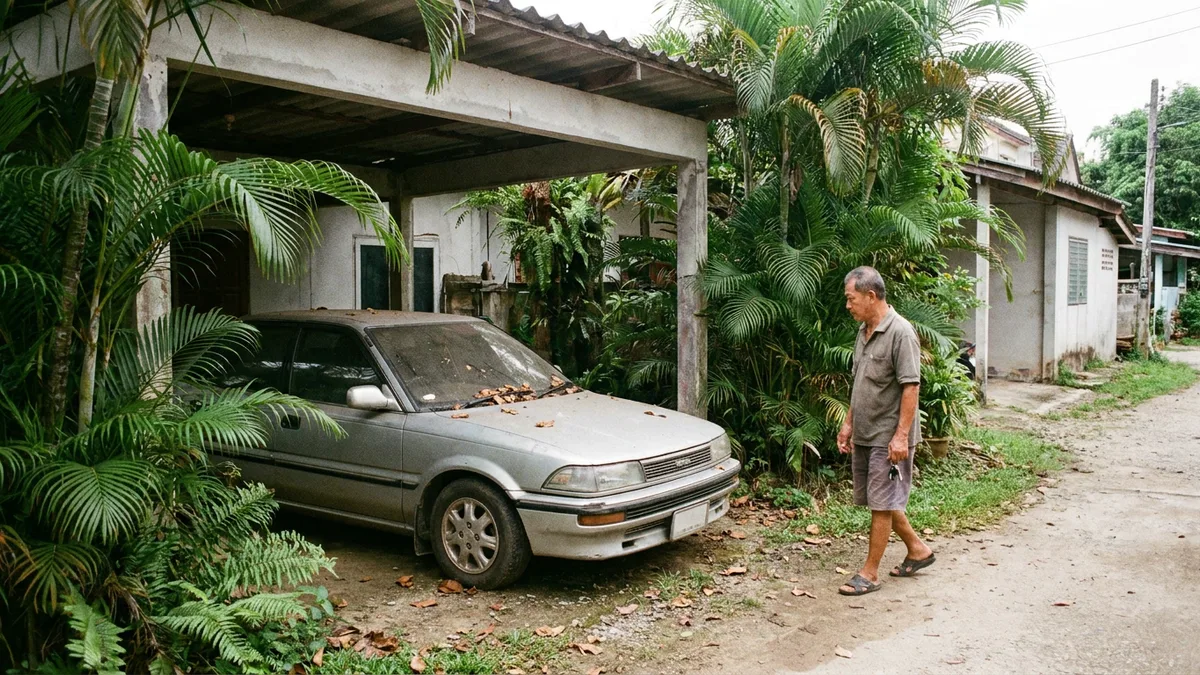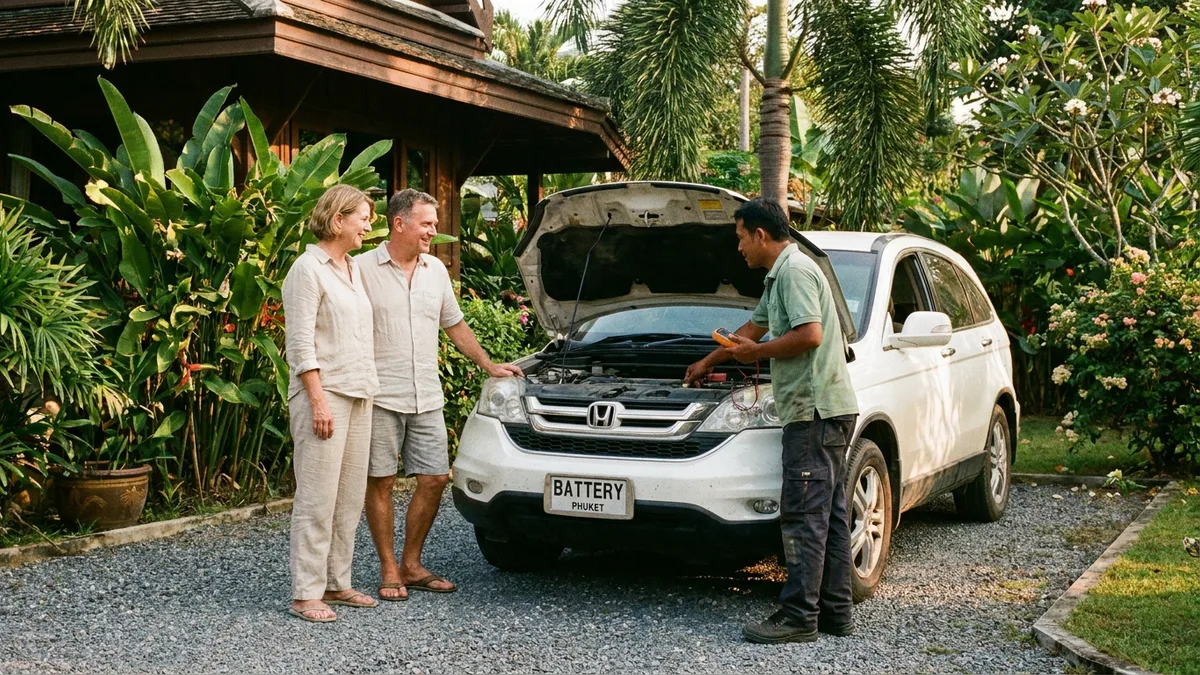
Phuket attracts a significant number of visitors who aren’t here for a week or two — they’re here for months. Snowbirds from Scandinavia and Australia who escape the northern winter, retirees who split their year between Thailand and home, digital nomads on six-month visa runs, and families who keep a second home on the island. Many of them own or lease a car, and many of those cars sit idle for extended stretches while their owners are away.
A car sitting in Phuket’s heat for six to eight weeks, or longer, creates a specific set of battery problems. The good news is that almost all of them are preventable with a little planning before you fly out. This guide is the pre-departure checklist: decide how the car will be looked after, park it sensibly, and get the battery checked before you go. Do that, and the difference is between a car that starts on your first morning back and a frustrating hour in your carport wondering why nothing works.
If you’ve already returned to a car that won’t start after sitting, this isn’t the page you need — head straight to our guide on why your car won’t start after sitting for diagnosis and what to do right now.
Why Idle Time Is Especially Hard on Batteries in Phuket
In any climate, a car battery slowly loses charge when the car isn’t being driven. Modern vehicles draw a small continuous current — typically 20–50 milliamps — from the battery even when everything is switched off. This “parasitic drain” keeps the alarm active, maintains ECU memory, and powers the clock and remote locking system. Left unchecked over weeks, this drain is enough to fully discharge the battery.
In Phuket’s tropical heat, two additional forces accelerate the problem:
Heat-driven self-discharge. Lead-acid batteries self-discharge faster at high temperatures. A battery at 35°C ambient loses charge roughly twice as fast as the same battery at 20°C. In Phuket, “ambient” means 30–36°C in the shade — and if your carport or parking spot isn’t well-shaded, the battery temperature can be significantly higher.
Electrolyte evaporation. Over weeks in high heat, water evaporates from the electrolyte in conventional flooded batteries. As electrolyte levels drop, the exposed lead plates begin to corrode and sulphate. This damage is largely irreversible and permanently reduces battery capacity.
The net result: a healthy battery left completely idle in Phuket without any maintenance can be severely discharged — or damaged beyond useful recovery — in as little as four to six weeks. In the worst cases, a car sitting for three months comes back to a battery that won’t hold a charge at all.
Options for Protecting the Battery While You’re Away
There are three main strategies, ranging from ideal to minimal:
Option 1: Use a Smart Battery Tender
The best solution for any absence longer than two weeks is a smart battery tender (also called a float charger or maintenance charger). This device plugs into a standard power outlet and connects to the battery via clips or a purpose-made SAE connector. It monitors the battery’s state of charge and delivers just enough current to keep it topped up without overcharging.
A quality smart tender — brands like CTEK, Noco, or Optimate are widely used — is not the same as a standard charger. It automatically cuts off and resumes charging as needed, so you can leave it connected indefinitely without risk of damage.
This is only possible if your parking space has access to electricity. Many Phuket condos and guesthouses can accommodate this with permission; villa parking typically has outdoor outlets.
Option 2: Have Someone Drive the Car Regularly
If electricity isn’t available, the next best option is having a trusted person drive the car for 30–40 minutes every two to three weeks. This allows the alternator to fully recharge the battery, prevents brake callipers seizing from long periods of disuse, and keeps the tyres from developing flat spots. A quick five-minute trip around the block does more harm than good — a short drive draws a big slug of current to restart the engine without giving the alternator time to put it back, leaving the battery slightly worse off than before.
This approach requires a genuinely trustworthy arrangement — ideally a neighbour, housekeeper, or building management staff member who is comfortable with the car. Make sure the car is insured for another driver before you leave, and leave clear instructions on where to park it back in the shade afterwards.
Option 3: Disconnect the Negative Terminal
If neither of the above options is practical, disconnecting the negative battery terminal before you leave eliminates parasitic drain entirely. It won’t prevent heat-related self-discharge and electrolyte evaporation, but it significantly slows the discharge rate.
To disconnect: use a 10mm wrench to loosen the nut on the negative (black, ”-”) terminal clamp and slide it off the post. Wrap the clamp in a cloth or rubber band to prevent accidental contact. When you return, reconnect the negative terminal, tighten firmly, and start the car.
Note that disconnecting the battery will reset the radio, clock, and some ECU settings, and a few cars need a radio security code re-entered afterwards. This is minor and easy to restore, but worth knowing.
For a step-by-step walk-through of doing this safely, see our guide on how to disconnect a car battery safely.
Where You Park Makes a Difference
Heat is the single biggest enemy of a parked battery in Phuket, so where you leave the car matters as much as how you maintain it:
- Park in the deepest shade you can find. A covered carport, basement garage, or the shaded side of a building keeps the battery many degrees cooler than open tarmac in full sun. Cooler means slower self-discharge and far less electrolyte evaporation.
- Avoid leaving it baking on open asphalt. A car parked in direct sun all day in Phuket can reach cabin and engine-bay temperatures well above ambient, which dramatically speeds up battery deterioration over weeks.
- Choose somewhere with a power outlet within reach if you intend to use a battery tender. This often decides whether Option 1 above is even possible, so factor it in when you pick the spot.
- Make sure everything is switched off. Before you walk away, confirm the interior and boot lights, dashcam, and any accessories are fully off — a single courtesy light left on can flatten a battery in days regardless of how well you’ve planned everything else.
Pre-Departure: What to Do Before You Leave
Preparing the battery before your departure takes about 30 minutes and significantly improves your odds of returning to a working vehicle:
-
Get a load test. If the battery is over two years old and hasn’t been tested recently, book a battery test before you leave. Batteries in Phuket’s heat typically last only 2–3 years, so an older one may already be marginal. Replacing a battery that’s at 60% capacity before a long absence is far better than returning to one that’s been deeply discharged for three months.
-
Check and clean the terminals. Remove any corrosion with a wire brush and a baking soda and water solution. Rinse and dry, then apply a light coat of petroleum jelly or anti-corrosion spray. Good terminal contact means the alternator can charge efficiently on every drive.
-
Check the electrolyte level (flooded batteries only). If the cells are low, top up with distilled water to the marked level. Do not use tap water or mineral water.
-
Decide on your storage method and arrange it before your flight, not the day you leave.
Pre-Arrival: Get a Battery Check Sorted in Advance
If you want to arrive back in Phuket to a car that definitely starts, our pre-arrival battery check service is the cleanest solution. Contact us before your return and we’ll schedule a battery inspection and test while you’re still away. If the battery needs replacement, we handle it before you land — you arrive to a working car with a new battery installed.
This is particularly useful for long-stay visitors who return to Phuket multiple times and want a reliable, zero-stress solution without becoming an expert in tropical battery storage logistics. See our car battery replacement service for what a typical battery swap involves.
The Broader Picture: Heat Takes a Toll Even on Active Batteries
Even if you never leave your car sitting for more than a few weeks, Phuket’s climate significantly shortens battery lifespan compared to temperate countries. Our guide on why car batteries die faster in Phuket’s heat explains the chemistry behind this, and our tropical climate care guide has practical steps for extending battery life during normal use.
If you’re planning an extended absence and want peace of mind when you return, reach out before you leave — a ten-minute inspection and an honest assessment of your battery’s health is a much better start to your next visit than a jump-start at the airport car park. And if you’ve arrived back to a car that’s already gone flat despite your best planning, our guide on why your car won’t start after sitting walks you through diagnosing it and getting moving again.