Owning a car in Phuket is a pleasure — until a dead battery leaves you sweating in a car park at noon with nowhere to be. The island’s climate is genuinely hard on batteries: year-round temperatures above 32°C, scorching under-bonnet heat when parked in the sun, high humidity, and the kind of short-trip driving that never quite gives the alternator time to do its job. The good news is that car battery care in a hot climate is not complicated. A handful of habits, done consistently, can meaningfully extend your battery’s life and save you from an unexpected breakdown.
This guide covers everything you need to know to keep your battery healthy in Phuket’s tropical conditions — from where you park to what to do before a long drive.
Why Tropical Battery Care Is Different
Before getting into the habits, it helps to understand why Phuket is particularly tough on batteries. Standard car batteries are designed and tested at around 25°C. Phuket’s ambient temperatures rarely drop below 28°C, and under-bonnet temperatures when a car is parked in direct sun can hit 80–90°C. At those temperatures, the internal chemistry of a battery runs faster — much faster — than it was designed to handle.
Electrolyte evaporates. Lead plates corrode. Sulfate crystals build up faster than charging can remove them. The result is that a battery which might last 4–5 years in Europe or North America typically lasts only 2–3 years here. For a deeper look at the chemistry involved, see our guide on why car batteries die faster in Phuket’s heat.
The practical takeaway: you can’t fight the climate, but you can reduce how aggressively it attacks your battery with a few simple habits.
Habit 1: Park in Shade Whenever You Can
This is the single most effective thing you can do. Under-bonnet temperatures when parked in full tropical sun are dramatically higher than in shade or a covered car park. Reducing that peak temperature — even by 20–30°C — slows electrolyte evaporation, reduces plate stress, and keeps the battery from heating beyond its designed range.
In Phuket, practical shade options include:
- Multi-story car parks at Central Festival, Lotus’s, Big C, and most major hotels
- Ground-level shade trees — far better than nothing, though they still allow some radiated heat
- Covered garages or carports at home
- Hotel covered parking — always worth asking whether your accommodation has it
Even if shaded parking adds a few minutes to your routine, the cumulative effect on battery life over a year is significant. It’s one of those habits that pays off quietly.
Habit 2: Drive Long Enough to Fully Recharge
A car’s alternator recharges the battery while the engine runs. The problem is that starting the engine is the most power-intensive thing a battery does — and a short drive of 5–10 minutes might not give the alternator enough time to put back what the starter motor took out.
In Phuket, many drivers use their car primarily for short local errands: a run to the market, school pickup, a quick trip to a restaurant 2 km away. That kind of driving pattern keeps a battery in a chronic state of partial charge, which accelerates sulfation and gradually shrinks capacity.
The fix: Aim for at least one drive of 20–30 minutes or more a few times a week. This gives the alternator time to top the battery up fully. If your daily driving really is all short trips, a monthly longer drive — or a maintenance charger — will compensate.
Habit 3: Use a Maintenance Charger If the Car Sits
This is especially relevant for expats who travel frequently, and tourists who rent a car for part of their trip and leave it parked. In Phuket’s heat, a parked battery self-discharges significantly faster than in cooler climates. A battery left sitting for two weeks in the heat — with only the car’s parasitic electrical loads drawing it down — can drop to a dangerously low state of charge.
A battery maintenance charger (often called a trickle charger or smart charger) plugs into a wall socket and keeps the battery at full charge without overcharging it. Quality units from brands like CTEK or Optimate are available in Phuket and are a sound investment if your car sits for more than 5–7 days at a time.
If a maintenance charger isn’t available, disconnecting the negative battery terminal when parking long-term eliminates parasitic loads and slows self-discharge. See our guide on how to disconnect a car battery safely for the correct procedure.
Habit 4: Keep Terminals Clean and Corrosion-Free
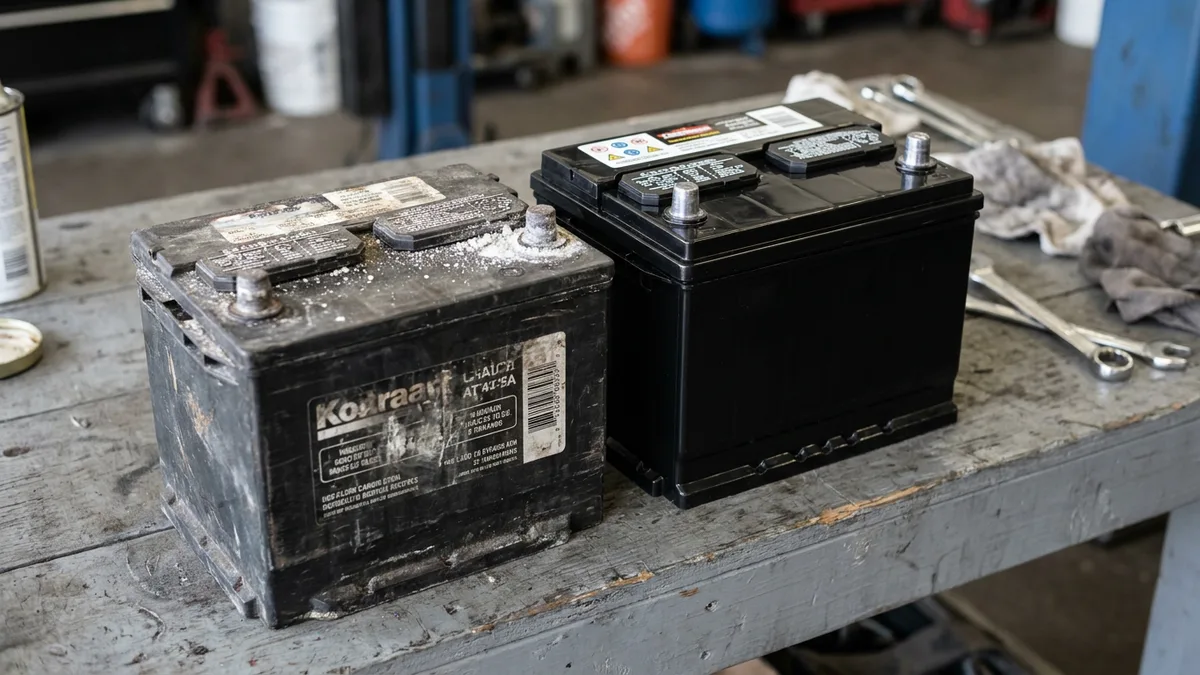
Battery terminal corrosion is extremely common in Phuket. The combination of heat and high humidity accelerates oxidation on the lead and copper surfaces, producing a white, chalky buildup (on the positive terminal) or a blue-green crust. This corrosion increases electrical resistance and forces the battery to work harder to deliver the same current, which shortens its life.
How to clean corroded terminals:
- Turn off the engine
- Disconnect the negative terminal first, then the positive
- Mix a tablespoon of baking soda with a cup of warm water
- Apply with an old toothbrush and scrub the terminals and cable ends
- Rinse with a little clean water and dry thoroughly
- Reconnect positive first, then negative
- Apply a thin layer of petroleum jelly or a commercial terminal protector spray
Do this every 3–6 months in Phuket’s climate. It takes ten minutes and makes a measurable difference to both battery life and reliable starting. You can also get your terminals checked as part of a battery testing appointment.
Habit 5: Minimize Battery Load When Idling
Running air conditioning, headlights, the radio, phone chargers, and other accessories while the engine is at idle — or turned off entirely — puts a heavy load on the battery. This is common in Phuket when people sit in the car with the AC running while waiting for someone, or when stuck in traffic on the way back from Karon.
Practical tips:
- If you need to sit with the AC on for more than 5–10 minutes, keep the engine running
- Never run the AC with only the ignition in the “on” position and the engine off — this drains the battery without the alternator running to compensate
- If your car is parked and you want to listen to the radio or charge a phone, run the engine
- Turn off all accessories before turning the engine off — this reduces the initial load the next time you start
Habit 6: Test Your Battery Before Long Trips
Phuket is a great base for longer driving adventures — north through Phang Nga, south toward Krabi, or across to the east coast. Before any extended trip, especially if your battery is more than 18 months old, it’s worth having it tested.
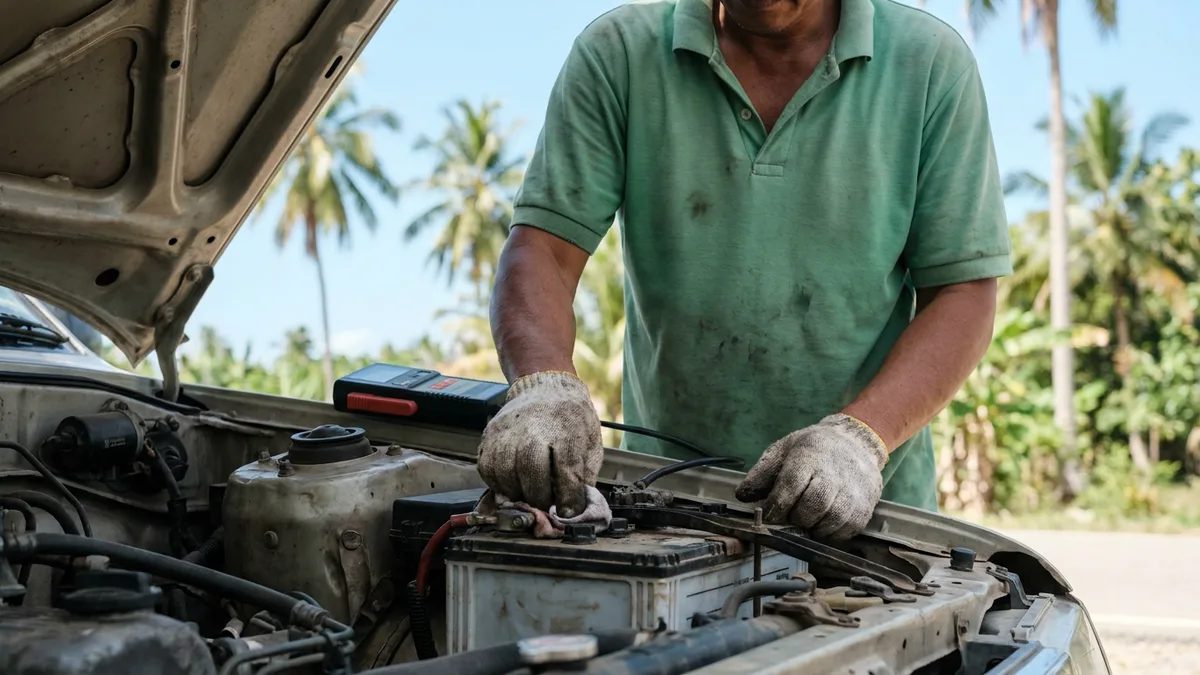
A proper load test (not just a voltage reading with a multimeter) tells you how well the battery can sustain power under real cranking conditions. A battery that shows 12.5 volts at rest can still fail a load test, meaning it’ll struggle on a hot day or after a long idle.
Our battery testing service takes under ten minutes and gives you a clear go/no-go answer. If the battery is borderline, it’s far better to replace it on your schedule in Phuket than to deal with a failure in a remote area of Khao Sok or on a mountain road in Phang Nga.
Habit 7: Replace on Your Timeline, Not the Battery’s
One of the most useful mindset shifts for Phuket car ownership is accepting that batteries are a 2–3 year consumable here, not a 5-year one. Once you internalize that, you can plan replacements proactively rather than being caught off guard.
| Battery Age in Phuket | Recommended Action |
|---|---|
| 0–18 months | Standard use; test if you notice any slow cranking |
| 18–24 months | Annual load test; note any warning signs |
| 24–36 months | Test every 6 months; start planning replacement |
| 36+ months | Replace proactively — failure risk is high |
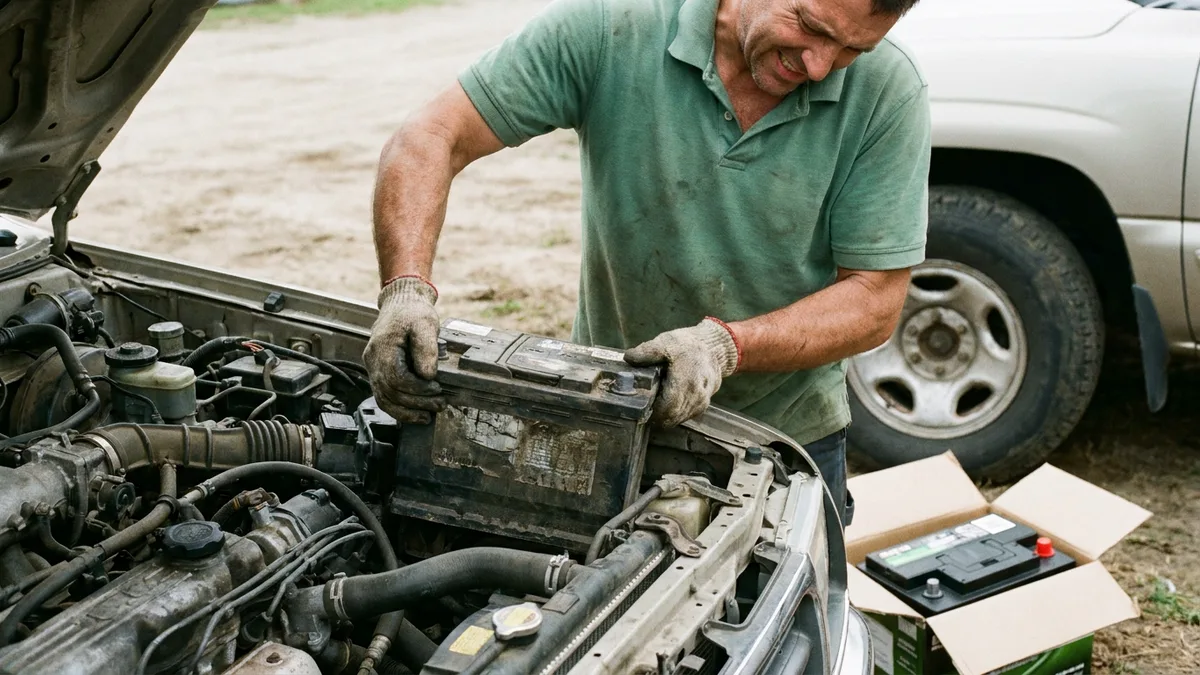
If your battery is approaching 2.5–3 years old and you’re planning a long trip or heading into the rainy season — when electrical demands from lights, wipers, and climate control increase — a proactive replacement is usually the smartest move. Our car battery replacement service is mobile and available across Phuket, so you can schedule it at your convenience.
A Word on Battery Choice in the Tropics
If you’re replacing a battery, consider upgrading to an AGM (Absorbed Glass Mat) battery if your vehicle supports it. AGM batteries handle heat better than standard flooded batteries, tolerate deeper discharges more gracefully, and cope better with the heavy air-conditioning loads common in tropical driving. They cost more upfront but often outlast standard batteries by a meaningful margin in Phuket’s conditions — making the total cost of ownership comparable or better.
For more on selecting the right battery for local conditions, our guide on how to choose the right car battery covers the key factors in detail.
Good battery care in Phuket really comes down to consistency: park smart, drive enough, keep connections clean, and test before you need to. If you ever need a hand with testing, a replacement, or just a quick health check before a big trip, we’re on call 24 hours a day across the island.