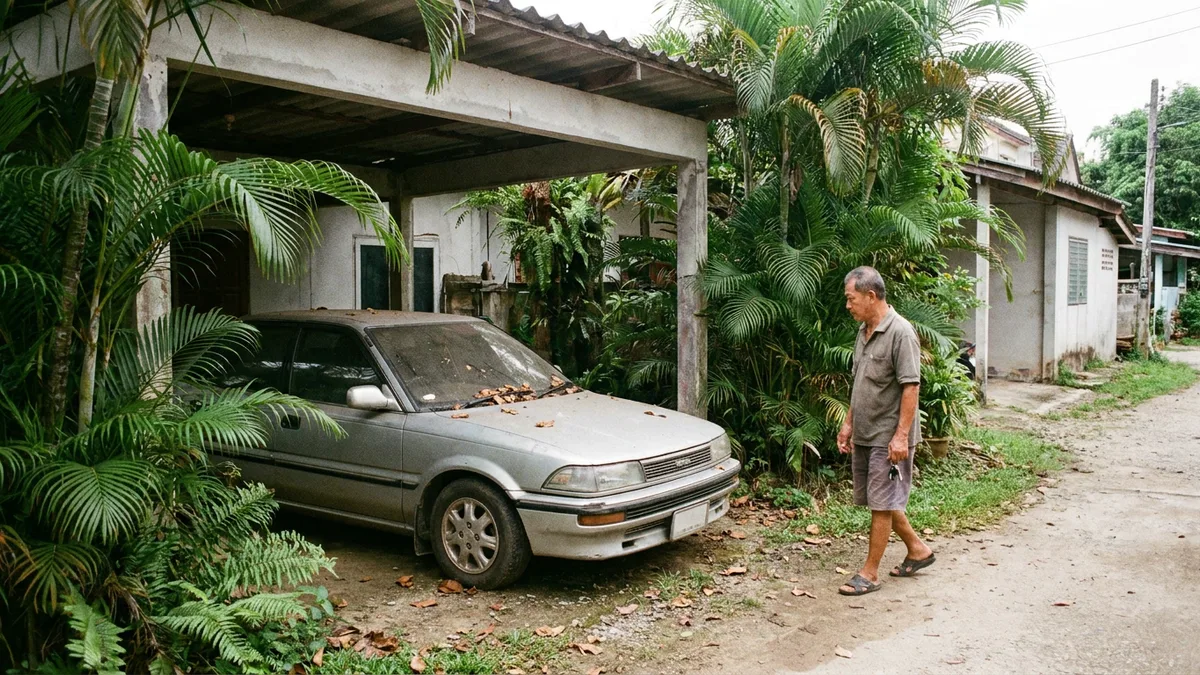
You’ve been away. Maybe it was a work trip to Bangkok, a few weeks back home, or simply a car you keep at the villa for weekend use that’s sat idle for the past month. You walk up, turn the key, and — nothing. Or a weak, grinding attempt that doesn’t make it. Your car won’t start after sitting, and in all likelihood you’re looking at a flat battery.
This is one of the most common scenarios we deal with in Phuket, particularly among expats and long-stay tourists who have a second vehicle, or who leave a rental or personal car parked for extended periods. This guide is about working out what’s wrong and getting you moving again. If you’re still planning a trip and want to avoid this happening in the first place, our long-stay car battery guide is the pre-departure checklist.
Why a Battery Goes Flat When a Car Sits
In nine cases out of ten, a car that won’t start after sitting has simply gone flat, and there are two reasons for that.
Self-discharge. A lead-acid battery slowly loses charge even with nothing connected — the internal chemistry keeps ticking over. A healthy, fully charged battery loses roughly 1–5% per week this way, and Phuket’s heat speeds it up considerably. A battery that might last 6–8 weeks in a cool European garage can reach the same flat state in 3–4 weeks here.
Parasitic drain. Every modern car keeps drawing a small current with the ignition off — for the ECU memory, clock, alarm, keyless-entry receiver, and any factory GPS tracker (common in Thailand for insurance) or wired-in dashcam. A normal drain is 20–50 milliamps (mA). Trackers and alarms can add 30–80 mA, pushing some cars to 80–150 mA — enough to flatten a smaller battery in as little as 5–10 days.
Stack a few weeks of parasitic drain on top of a battery that’s already lost capacity to the heat — and batteries in Phuket typically last only 2–3 years — and it doesn’t take long to reach the point where there’s no longer enough punch to crank the engine. For the full chemistry of why the climate is so hard on batteries, see why car batteries die faster in Phuket’s heat.
Step 1: Read the Symptoms — Is It Really the Battery?
Before you reach for jumper leads, listen to what the car does when you turn the key. The symptom tells you how flat the battery is — and, crucially, whether the battery is even the problem:
- Dim or flickering lights, slow laboured crank: Battery is partly discharged. It may catch on the second attempt or with a brief boost. Most likely a flat battery.
- Single click or rapid clicking, no crank: The starter solenoid is engaging but there isn’t enough current to turn the motor. Classic flat battery.
- Complete silence, dash dim or dead: Severely discharged battery, a collapsed cell, or a loose/corroded terminal. Needs charging, a clean connection, or replacement.
- Engine cranks at normal speed but won’t fire: The battery is probably fine — look instead at fuel, ignition, a sensor, or the immobiliser (see the next section).
- Starts then immediately stalls: Rarely the battery on its own; can point to fuel or sensor issues after a long sit, though this is uncommon with modern sealed fuel systems.
Step 2: Rule Out the Other Suspects
A flat battery is the usual culprit after sitting, but a few other things can masquerade as one. Quickly rule them out so you don’t replace a perfectly good battery:
- Corroded or loose terminals. Weeks of damp and heat can leave a fuzzy white or green crust on the posts, or a clamp can work loose. This mimics a flat battery exactly — dim lights, no crank. Wiggle each clamp; if it moves, tighten it. If it’s crusted, our guide on cleaning corroded battery terminals shows how to clean and reseat them.
- The alternator. The alternator doesn’t usually fail while a car sits, but if the battery went flat because a tired alternator wasn’t fully charging it during your last drives, it’ll keep happening. A healthy charging system reads about 13.7–14.7 V at the battery with the engine running; a resting battery reads about 12.6 V. If you’re not sure which part is at fault, battery vs alternator: which is failing walks through the checks.
- The starter motor. If you get a single solid clunk (not the rapid clicking of a flat battery) and the lights stay bright, the starter itself may be the problem rather than the battery.
- The immobiliser or key. A car that cranks happily but won’t fire, with a security light flashing on the dash, may not be recognising the key — a flat key-fob battery is a common, easily fixed cause.
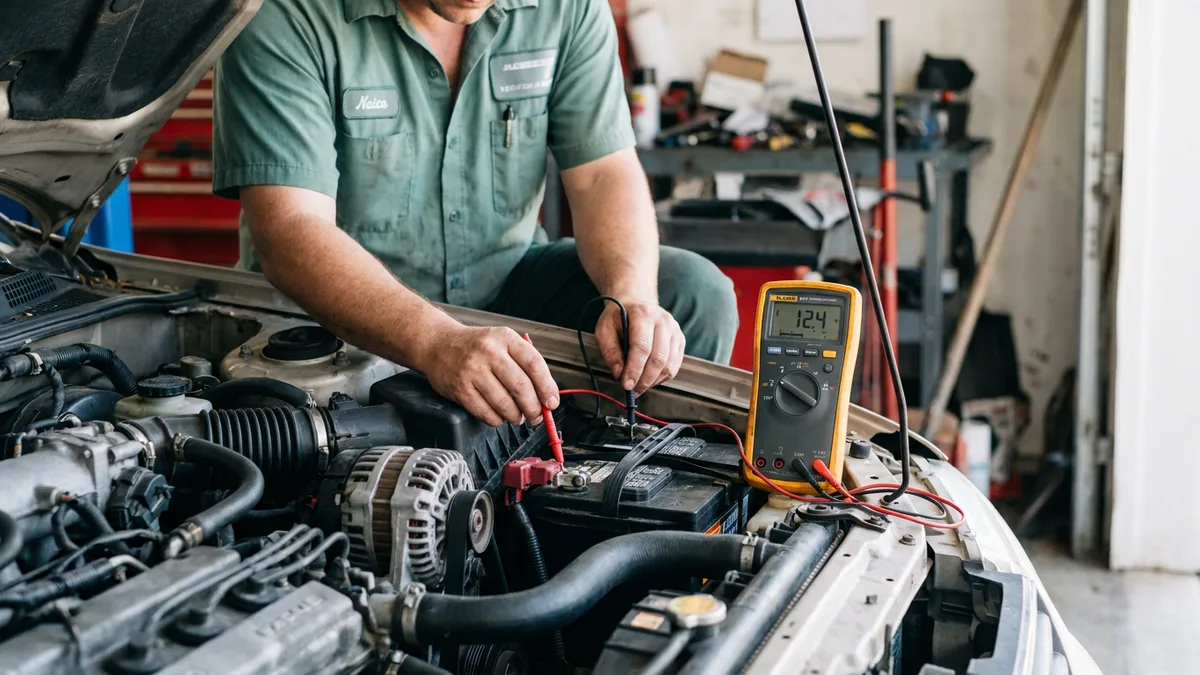
A two-minute check with a multimeter settles most of this. If you have one, our guide on how to test a car battery with a multimeter shows what the numbers mean.
Step 3: Get It Started
Once you’re confident it’s a flat battery, here’s what to do right now:
Jump-start it. Connect jumper cables or a portable jump-pack (booster pack) to the flat battery, positive lead first, negative lead to a bare metal earth point on the flat car rather than its battery terminal. Let the good source feed the flat battery for 3–5 minutes before attempting to start. If the car fires up, leave it running for at least 30–45 minutes so the alternator can put a meaningful charge back. For the full method, see how to jump-start a car with cables or, for a booster pack, how to jump-start with a jump-starter pack.
Do not attempt to jump a battery that is cracked, leaking, or visibly swollen — that one needs replacing, not boosting. Our jump-start service is available 24 hours throughout Phuket if you don’t have cables or a helper vehicle nearby.
Test the battery afterwards. A battery that accepts a jump isn’t necessarily healthy — it may be too degraded to survive the next time the car sits. Our battery testing service uses a digital load tester that tells you definitively whether enough capacity remains to be reliable.
Replace it if it’s old or fails the test. If the battery is more than 2–3 years old in Phuket’s climate and has been deeply discharged more than once, replacement is usually more economical than hoping it recovers. We offer on-site car battery replacement at your location.
When to Stop and Call for Help
You can safely jump-start a healthy battery yourself, but call a professional rather than persisting if:
- The car still won’t crank after a correctly connected jump — the battery may be beyond recovery, or the fault isn’t the battery at all.
- The battery is cracked, leaking, swollen, or smells of rotten eggs (sulphur). Stop and ventilate the area; that battery is unsafe to charge or jump.
- The engine cranks normally but won’t fire, pointing to fuel, ignition, or immobiliser problems rather than the battery.
- You’re stranded somewhere awkward, it’s the middle of the night, or you simply don’t have leads and a donor car to hand.
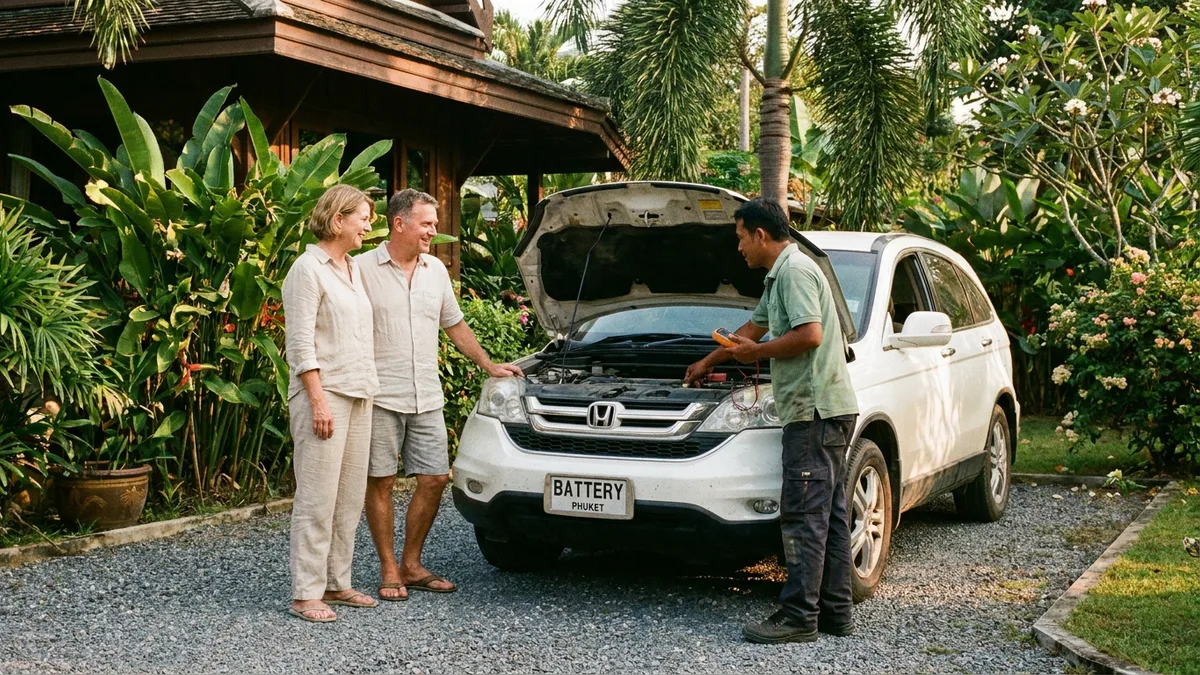
We come to you anywhere in Phuket, day or night, test the battery on the spot, and either get you moving or fit a new battery there and then.
So It Doesn’t Happen Again
Getting the car going is only half the job — if nothing changes, a car that sits will simply go flat again. We see the same loop constantly: someone leases a car, flies home for 3–4 weeks, returns to a flat battery, jump-starts it, heads off again, and repeats. Breaking the cycle comes down to a little planning before the next absence — keeping the battery charged with a smart tender, disconnecting it, having someone drive it, and parking in the shade.
Rather than repeat all of that here, we’ve put the full pre-departure plan in one place: our long-stay car battery guide covers every option for keeping a parked car’s battery alive in Phuket, including which suits months away versus a few weeks. The single most valuable habit is getting the battery load-tested before a long trip — sorting out a marginal battery in advance is far easier than dealing with it on arrival day when you’re jet-lagged with luggage to move.
If you’re back in Phuket and facing a car that won’t start after sitting, we’re available day or night — call us and we’ll get you going again.